Indoor vs. Outdoor Pickleball: What Changes and How to Adjust
Compare indoor and outdoor pickleball balls, court surfaces, conditions, gear, and strategy so you can adjust quickly and play your best anywhere.
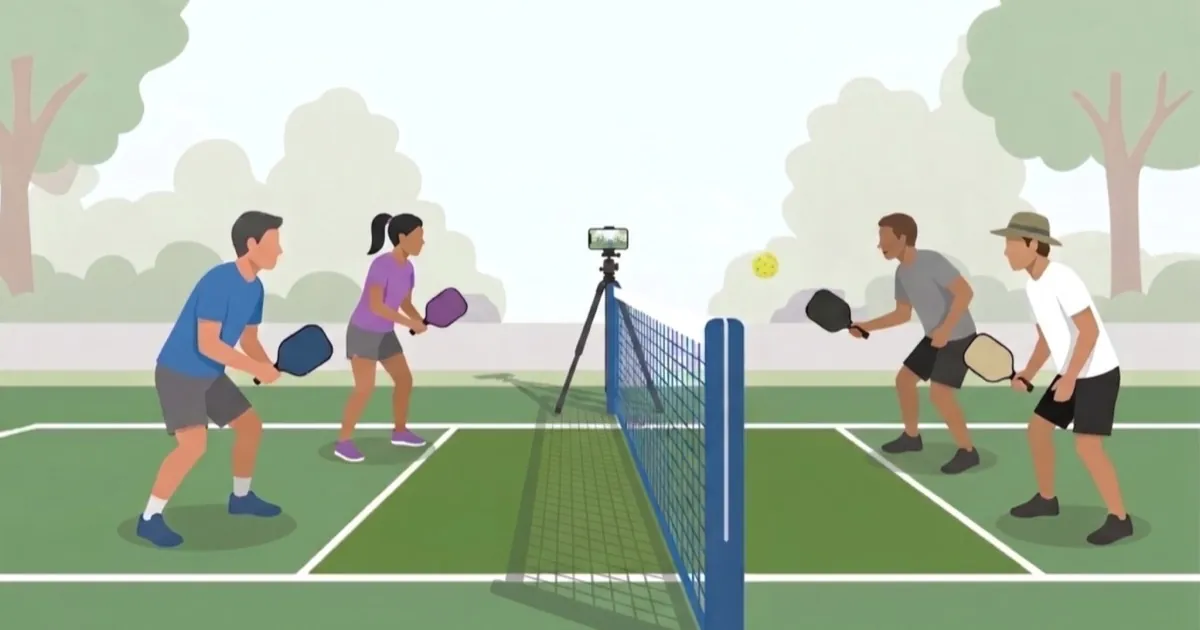
The court dimensions, kitchen, net height, and basic rules do not change when pickleball moves indoors. The experience definitely does.
The ball may feel softer or firmer. A gym floor can reward compact strokes while an outdoor acrylic court offers more grip. Wind, sun, lighting, temperature, noise, and backgrounds all affect how early you see the ball and how confidently you move.
The best players do not treat indoor and outdoor pickleball as different sports. They identify what changed, make a few practical adjustments, and settle in.
Indoor vs. Outdoor Pickleball at a Glance
| Factor | Typical indoor play | Typical outdoor play |
|---|---|---|
| Ball | Softer ball with fewer, larger holes | Firmer ball with more, smaller holes |
| Surface | Wood, polished concrete, or indoor sport surface | Textured acrylic over concrete or asphalt |
| Flight | Consistent air, often a slower-feeling ball | Wind and temperature can change the flight |
| Footing | May feel smooth or slick | Usually more grip and more shoe wear |
| Visibility | Overhead lights, rafters, curtains, mixed court lines | Sun, shadows, fences, sky, and changing light |
| Strategy | Compact preparation and fast reactions | More margin for weather and changing conditions |
These are common patterns, not guarantees. A dedicated indoor facility may have the same textured acrylic surface and 40-hole ball you use outside. A covered outdoor-style court can play more like an outdoor court even though there is a roof overhead.
The most useful question is not simply “Am I inside?” It is “What ball, surface, and conditions am I playing with?”
The Ball Is the Biggest Equipment Difference
Traditional indoor balls are softer and usually have fewer, larger holes. Many popular models have 26 holes. They tend to feel lighter off the paddle, move a little slower, and respond noticeably to spin. Their softer plastic also holds up well on smooth gym floors.
Traditional outdoor balls are firmer and commonly have 40 smaller holes. The smaller-hole pattern and firmer construction help produce a more stable flight in moving air and survive rough court surfaces. They often feel faster and louder off the paddle, especially in warm conditions.
There is an important rules detail here: “indoor” and “outdoor” are customary labels, not an absolute legal restriction. The USA Pickleball rulebook allows approved balls with 26 to 40 circular holes and says approved balls may be used indoors or outdoors. In a tournament, the event chooses the ball.
How to Adjust to an Indoor Ball
- Expect the ball to compress a little more and come off the paddle with less pace.
- Finish your serves and drives instead of guiding them.
- Be ready for spin to move the ball after the bounce.
- Use compact swings when rallies speed up on a smooth floor.
How to Adjust to an Outdoor Ball
- Prepare for a firmer, faster response off the paddle.
- Shorten your backswing if your drives are sailing long.
- Give drops and dinks extra margin until you learn the ball’s feel.
- Check the ball for cracks or soft spots, especially in cold weather.
Warm up with the exact ball you will use in the match. Ten minutes with the right ball teaches you more than guessing from the label.
Court Surface Matters More Than the Building
Players often use “indoor” to mean a wood gym floor and “outdoor” to mean textured acrylic. That shorthand is useful, but it can also be misleading.
Smooth Indoor Surfaces
Wood and polished sport floors can feel quick because the ball and your shoes interact differently with the surface. You may notice:
- Lower or skidding bounces
- Less confidence stopping or changing direction
- Faster-feeling exchanges despite a softer ball
- Extra visual clutter from basketball, volleyball, and badminton lines
Stay balanced, use smaller adjustment steps, and avoid lunging. If the floor is dusty or damp, stop and address it before playing.
Textured Hard Courts
Outdoor-style acrylic courts generally provide more traction and a truer, more familiar bounce. That grip helps movement, but it also wears down shoes and balls faster. Your outdoor shoes should have a durable outsole and strong lateral support.
Some indoor clubs use this same surface. When they do, your movement and ball bounce may feel almost identical to outdoor play, minus the weather.
How Conditions Change Your Strategy
Playing Indoors
Indoors removes wind and sun, so placement becomes more repeatable. Use that predictability to be more precise with serves, returns, drops, and dinks.
The tradeoff is visual and acoustic distraction. Bright overhead lights can hide a lob for a moment. Rafters and curtains can make ball tracking difficult. Multiple games in one gym can make partner communication harder.
Indoor priorities:
- Use a shorter backswing. Compact preparation helps when the floor and close background make the ball feel fast.
- Call the ball early. Noise makes late communication useless.
- Track with your head. Keep your eyes and head moving together, especially on high balls near the lights.
- Respect the surface. Split step under control instead of planting and cutting aggressively on a slick floor.
Playing Outdoors
Outdoors adds variables. The wind can push a lob, hold up a drop, or move a serve after you have committed to it. Sun and shadows can delay your read. Cold makes many balls harder and more likely to crack, while heat can soften them.
Outdoor priorities:
- Test the wind before the game. Hit a few drops, lobs, and serves in both directions.
- Use more margin. Aim farther inside the lines and a little lower in gusty conditions.
- Keep the ball in front. Compact swings are easier to time when the wind changes the flight.
- Adjust by court end. A shot that works with the wind may need a different target when you change sides.
- Protect your vision. A hat, sunglasses made for court sports, and early communication help with sun and glare.
Strong wind usually makes high, floating shots riskier. Favor lower drives, controlled drops, and larger targets. If you do lob, know whether you are hitting into the wind or with it before you commit.
Do You Need Different Paddles or Shoes?
You do not need an indoor paddle and an outdoor paddle. The same legal paddle works in both environments.
Shoes are different. A durable hard-court outsole is designed to survive rough acrylic. A non-marking indoor court shoe may feel excellent on wood but wear down quickly outside. If you play regularly on both surfaces, dedicated pairs can improve traction and extend the life of each shoe.
Whatever you wear, choose court shoes built for lateral movement. Running shoes are designed primarily for forward motion and do not provide the same side-to-side stability.
A Five-Minute Adjustment Routine
Use the beginning of every warmup to calibrate instead of hitting mindlessly.
- Bounce the ball by hand. Notice its firmness and bounce height.
- Hit five dinks. Learn how much the ball jumps off the paddle.
- Hit five drops from midcourt. Calibrate touch and arc.
- Hit five baseline drives. Check pace, depth, and spin.
- Hit serves and returns from both ends. Look for wind, glare, skid, and background issues.
Tell your partner what you noticed. “The far end is into the wind” or “the ball is skidding on this floor” is useful information. “Everything feels weird” is not.
Which Is Better: Indoor or Outdoor Pickleball?
Neither is automatically better.
Indoor pickleball offers reliable scheduling, controlled air, and consistent conditions. It is excellent for focused practice because the environment changes less from shot to shot.
Outdoor pickleball offers the traditional hard-court feel, more space, and the challenge of adapting to real conditions. It develops problem-solving because the same shot may behave differently from one end of the court to the other.
Playing both can make you a more complete player. Indoor sessions sharpen precision and reactions. Outdoor sessions teach margin, resilience, and adjustment.
The Bottom Line
The rules stay the same, but the ball, surface, and environment can change the way every shot feels. Warm up with purpose, identify the biggest variable, and make one adjustment at a time.
If you want help adapting your game, Coach Pickle can suggest drills for your court conditions, help you troubleshoot shots that break down indoors or outside, and build a practice plan around the surfaces you actually play on.
Want Personalized Coaching?
Coach Pickle gives you an AI pickleball coach in your browser or on your phone. Get strategy advice, drills, and mental game coaching tailored to your skill level.