Best Pickleball Apps in 2026: A Complete Comparison
Compare the best pickleball apps of 2026 across coaching, scoring, court finding, and community categories. Find the right app for your game.
Best Pickleball Apps in 2026: A Complete Comparison
The pickleball app ecosystem has matured significantly. A few years ago, finding a decent pickleball app meant settling for a basic scorekeeping tool or a generic sports tracker that happened to include pickleball. In 2026, there are dedicated apps covering virtually every aspect of the sport, from AI-powered coaching to court finding to video analysis.
With so many options available, choosing the right apps for your needs can be overwhelming. This guide breaks down the major categories of pickleball apps, what to look for in each, and how to build a toolkit that actually helps you improve and enjoy the game more.
Categories of Pickleball Apps
Pickleball apps generally fall into five main categories. Most players benefit from having at least one app from two or three of these categories.
1. Coaching and Instruction Apps
These apps focus on helping you improve your game through lessons, drills, tips, and personalized feedback.
What to look for:
- Personalization. The best coaching apps adapt to your skill level and goals rather than offering one-size-fits-all content. An app that knows you are a 3.5 player working on your third shot drop is far more useful than one that serves the same generic tips to everyone.
- Depth of content. Look for apps that cover technique, strategy, mental game, and match play rather than just basic stroke instruction.
- Interactive coaching. Static video libraries have their place, but the most effective coaching apps let you ask questions, describe specific situations, and get tailored responses.
- Progress tracking. Good coaching apps help you see where you started, what you have worked on, and how you have improved over time.
- Multiple coaching perspectives. Different players respond to different teaching styles. Apps that offer variety in coaching approach or personality tend to serve a wider range of learners.
Common limitations:
- Video-only apps can feel passive if they lack interactive elements
- Some apps focus heavily on beginners and have limited content for advanced players
- Subscription fatigue is real when coaching apps charge premium prices for limited content updates
2. Scoring and Match Tracking Apps
These apps replace manual scorekeeping and add data tracking to your matches.
What to look for:
- Easy-to-use interface. If it takes longer to enter a score than to play the point, the app is not helping. Look for large buttons, simple layouts, and quick input methods.
- Rally scoring and traditional scoring support. With the sport transitioning between scoring formats, your app should handle both.
- Statistics tracking. Beyond the score, useful stats include serving percentage, unforced errors, winners, and point patterns.
- Match history. Being able to look back at past matches and see trends in your performance is valuable for long-term improvement.
- Offline functionality. Many courts do not have reliable cell service. Your scoring app should work without an internet connection.
Common limitations:
- Manual stat entry during a match can be distracting
- Accuracy depends entirely on consistent data entry
- Most scoring apps do not provide coaching or analysis based on the data they collect
3. Court Finding and Booking Apps
These apps help you find courts near you, check availability, and in some cases reserve time slots.
What to look for:
- Comprehensive court database. The app should include both public and private courts in your area, with accurate information about the number of courts, surface type, and amenities.
- Real-time availability. For courts that accept reservations, real-time booking through the app saves time.
- User reviews and ratings. Community feedback on court quality, lighting, net condition, and crowding is extremely helpful.
- Travel features. If you travel and want to find courts in new cities, a broad national or international database is important.
- Integration with maps. Seamless navigation to courts you have not visited before.
Common limitations:
- Court databases are only as good as their maintenance, and many have outdated information
- Booking features are only available for courts that have partnered with the app
- Coverage varies significantly by region
4. Video Analysis Apps
These apps let you record and analyze your play to identify technical and tactical improvements.
What to look for:
- Slow-motion playback. The ability to slow down footage frame by frame is essential for analyzing stroke mechanics.
- Drawing and annotation tools. Being able to mark up video with lines, circles, and arrows helps you visualize what you are seeing.
- AI-powered analysis. The most advanced video apps use artificial intelligence to automatically detect technical issues, track ball trajectory, and identify patterns in your play.
- Side-by-side comparison. Comparing your technique to a reference or to your own footage from months ago is a powerful learning tool.
- Easy sharing. If you work with a coach or practice partner, being able to share clips easily speeds up the feedback loop.
Common limitations:
- Quality of analysis depends heavily on camera angle and video quality
- AI analysis is still developing and may miss subtleties that a human coach would catch
- Storage requirements for video can fill up a phone quickly
5. Community and Social Apps
These apps connect you with other players for open play, leagues, tournaments, and social interaction.
What to look for:
- Active local community. The best community app in the world is useless if nobody in your area uses it. Check how active the user base is in your region before committing.
- Event organization. Features for creating and joining round robins, ladder leagues, and informal meetups.
- Skill-level matching. The ability to find players at your level for competitive or practice sessions.
- Communication tools. In-app messaging, group chats, and event notifications keep the community connected.
- Tournament integration. Some community apps connect with tournament platforms for registration and bracket tracking.
Common limitations:
- Network effects mean you may need to use whatever app your local community has adopted, even if it is not the best
- Moderation and community management vary widely
- Feature overlap with general social media and messaging apps
What Makes a Great Pickleball App
Across all categories, the best pickleball apps share a few common qualities.
Built for Pickleball, Not Adapted From Something Else
Apps designed specifically for pickleball understand the sport’s unique terminology, rules, and culture. Generic fitness or sports apps that bolt on a pickleball module rarely capture the nuances that dedicated apps do. Look for apps built by people who clearly play and understand the sport.
Respects Your Time
You downloaded the app to improve your game or find a court, not to navigate a cluttered interface or sit through unskippable tutorials. The best apps get you to the value quickly and stay out of your way.
Updates Regularly
Pickleball is evolving rapidly with new rules, strategies, and community norms. Apps that update regularly with fresh content, feature improvements, and bug fixes show that the team behind them is actively invested in the product.
Works Offline When Needed
Courts are not always in areas with strong cell coverage. Coaching content, scoring tools, and saved data should be accessible without a connection.
Building Your Pickleball App Toolkit
You do not need ten apps on your phone. Most players are well served by two or three that cover their primary needs.
If you are focused on improvement: Start with a coaching app and a video analysis tool. The coaching gives you direction, and the video lets you see what you are actually doing versus what you think you are doing.
If you are focused on playing more: A court finding app and a community app will help you get on the court more often and find the right people to play with.
If you are a competitive tournament player: A scoring and stats app, a coaching app, and a community app cover your bases for preparation, tracking, and connection.
How Coach Pickle Stands Out in the Coaching Category
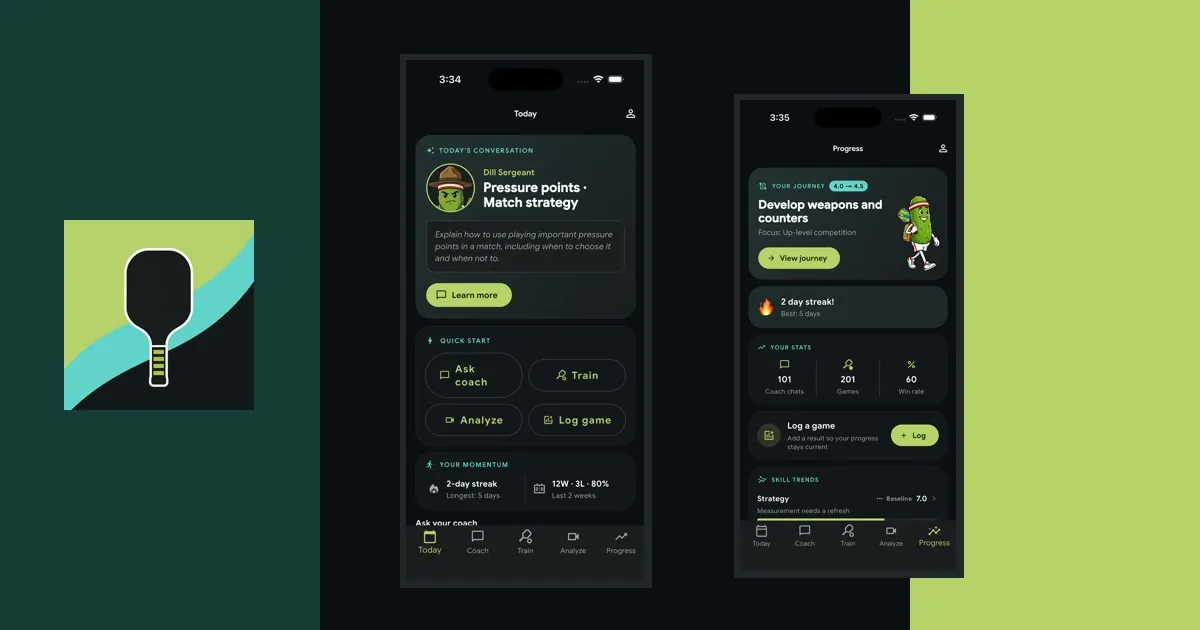
Coach Pickle is an AI-powered coaching app built exclusively for pickleball players who want to improve their game. What distinguishes it in the coaching category is its conversational approach to instruction. Instead of scrolling through a library of pre-recorded videos, you interact with AI coach personalities that adapt to your level, your questions, and your goals in real time.
The app covers the full spectrum of pickleball development, from technical fundamentals to advanced strategy to the mental game. Multiple coach personalities offer different teaching styles, so you can find the approach that resonates with how you learn. Whether you are a 3.0 player looking to build a foundation or a 4.0 player fine-tuning your competitive game, Coach Pickle provides personalized, on-demand coaching without the cost of private lessons.
The pickleball app landscape will continue to evolve as the sport grows. The best approach is to start with the tools that address your most pressing needs, give them an honest trial, and adjust your toolkit as your game and goals develop.

Want Personalized Coaching?
Coach Pickle gives you an AI pickleball coach in your browser or on your phone. Get strategy advice, drills, and mental game coaching tailored to your skill level.