Pickleball Singles Strategy: How to Win 1v1
Dominate pickleball singles with proven strategies for positioning, shot selection, and fitness. Learn the key differences from doubles and how to win 1v1.
Why Singles Pickleball Is a Different Game
If you have been playing doubles and decide to try singles for the first time, you are going to feel like you are playing a different sport. The strategies that work in doubles, like patient dinking rallies and cooperative net play, do not translate directly to the singles court.
In singles, you are covering the entire court by yourself. There is no partner to cover your weaknesses, no one to poach a ball in the middle, and no one to communicate strategy with between rallies. Every inch of the court is your responsibility.
This means singles pickleball rewards different skills: fitness, shot placement, mental toughness, and the ability to construct points with purpose. Here is how to build a winning singles strategy.
Key Differences Between Singles and Doubles
Before diving into strategy, it is important to understand what changes when you go from doubles to singles.
- Court coverage. You are covering approximately 440 square feet by yourself instead of splitting it with a partner. Movement and recovery become critical.
- The kitchen is less dominant. In doubles, controlling the kitchen line wins points. In singles, the kitchen is important but not the only winning position. Many points are won with deep ground strokes and passing shots.
- Serving matters more. You serve every other point (rather than every fourth), and serve placement directly sets up your next shot.
- Fitness is a factor. Singles rallies often involve more running, especially if both players are staying back and working angles.
- Scoring is different. Singles uses a two-number scoring system instead of three. The server’s score is called first, then the receiver’s score.
Serve Strategy for Singles
Your serve sets the tone for every rally. In singles, you have the freedom to be more strategic with serve placement because you only need to cover one side of the court.
Serve Deep to the Backhand
Most players have a weaker backhand than forehand. Serving deep to your opponent’s backhand forces a more difficult return and gives you a better look at the third shot. Depth matters even more than placement, though. A serve that lands within two feet of the baseline restricts your opponent’s options significantly.
Vary Your Serve Location
Do not serve to the same spot every time. Mix deep serves to the backhand with occasional serves to the forehand, down the center line, or out wide. Keeping your opponent guessing prevents them from grooving a return.
Use Your Serve Position
In singles, you serve from the right side when your score is even and the left side when your score is odd. Use this to your advantage. When serving from the right, a serve to the outside corner can pull your opponent wide, opening up the court for your next shot.
For more on serving mechanics and types, see our breakdown of pickleball serve techniques.
Court Positioning in Singles
The Baseline Game
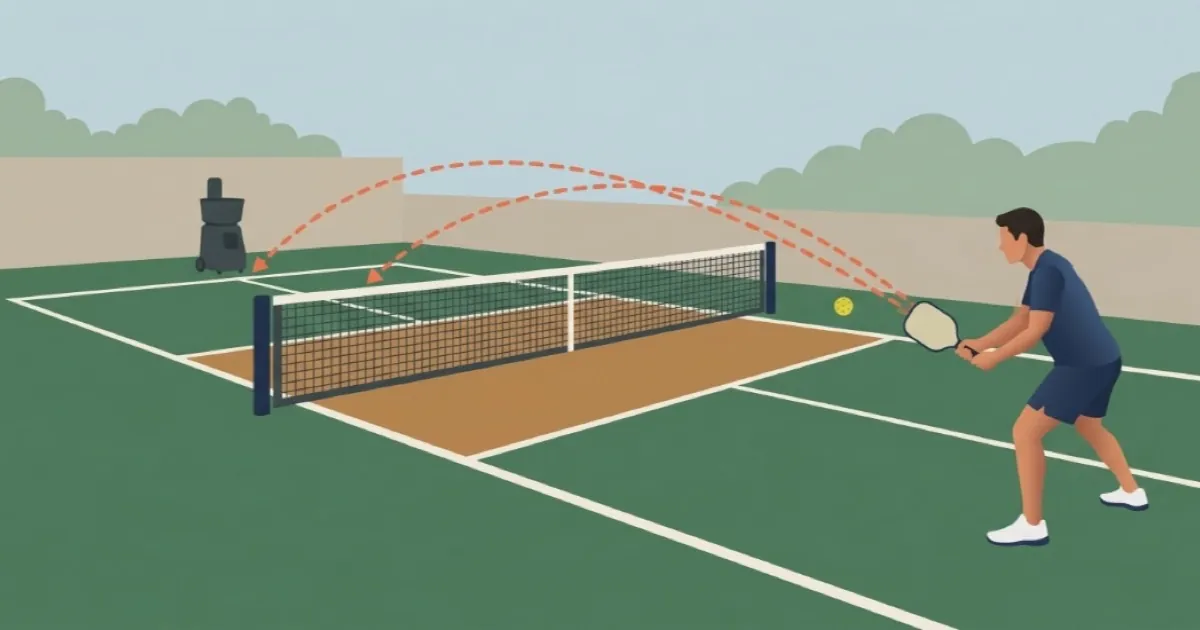
Unlike doubles, staying at or near the baseline is a valid strategy in singles. Many successful singles players rally from the baseline, using deep ground strokes to move their opponent side to side until an opening appears.
If you choose to play from the baseline:
- Recover to the center after every shot. The center of the baseline gives you the best coverage of the full court.
- Hit deep. Keep your shots landing near your opponent’s baseline to prevent them from attacking.
- Work the angles. Cross-court shots to alternating corners tire your opponent and create open court.
When to Come to the Net
Coming to the net in singles is a calculated decision, not a default position. Move forward when:
- You hit a quality drop shot or short ball that forces your opponent to hit from below the net
- Your opponent is out of position and cannot hit a passing shot
- You have a short ball to attack and can approach with a firm shot to a corner
When you come to the net, position yourself based on where your shot went. If you hit to the right side of the court, shade slightly right of center. This cuts off the most likely return angle while still covering the down-the-line pass.
Avoid No-Man’s Land
The area between the baseline and the kitchen line is dangerous in singles just like in doubles. If you are at mid-court, you are vulnerable to shots at your feet and passing shots. Either commit to moving all the way to the kitchen line or stay back at the baseline.
Shot Selection for Singles
Deep Cross-Court Ground Strokes
This is the bread-and-butter shot of singles pickleball. A deep cross-court shot gives you the best margin for error (the net is lowest in the center and the court is longest diagonally) while moving your opponent away from the center of the court.
The Drop Shot
A well-timed drop shot in singles can be devastating. After pushing your opponent deep with ground strokes, a soft drop shot into the kitchen forces them to sprint forward. If they get to it, you can often pass them on the next shot because they are moving forward and cannot change direction quickly.
The Passing Shot
When your opponent comes to the net, you have two options: pass them or lob. A firm shot aimed at their feet or to the open side of the court is the passing shot. Keep it low to make the volley difficult.
The Lob
If your opponent is at the kitchen line and leaning forward, a well-placed lob over their head can win the point outright or at minimum push them back to the baseline, resetting the rally. Use it sparingly though, because a short lob is an easy overhead putaway.
Down-the-Line Shots
Going down the line changes the direction of the rally and can catch your opponent moving the wrong way. Use this when your opponent is shaded toward the crosscourt angle.
Movement and Fitness
Singles pickleball is physically demanding. Here is how to manage the court efficiently.
Recovery Steps
After every shot, take quick recovery steps back toward the center of the court. Do not admire your shot and stand where you hit it. Move immediately. Small, quick steps are better than large lunges.
Split Step
When your opponent is about to hit the ball, perform a split step. This is a small hop where you land on both feet shoulder-width apart, ready to move in any direction. The split step is the foundation of good court coverage.
Managing Your Energy
Singles points can be long. Do not sprint at full speed for every ball early in the match if it means you are exhausted in the third game. Be efficient with your movement. Take the shortest path to the ball and recover with controlled steps.
Build your fitness outside of pickleball as well. Lateral agility drills, short sprints, and leg strengthening exercises all translate directly to better singles play.
Mental Strategy for Singles
Play to Your Strengths
If you have a strong forehand, structure rallies so you hit as many forehands as possible. Position yourself to use your best shots and force your opponent to deal with what you do well.
Exploit Weaknesses
Pay attention to your opponent’s patterns. Do they struggle with backhands? Do they hate coming to the net? Are they slow recovering to the center? Identify weaknesses early and target them consistently.
Stay Consistent Under Pressure
In close games, the player who stays composed usually wins. Avoid the temptation to go for risky winners when the score is tight. Keep the ball deep, make your opponent work, and wait for the right opportunity.
Control the Pace
If your opponent likes a fast game, slow it down with drops and soft shots. If they prefer to rally slow, speed things up with drives and deep serves. Making your opponent play at a tempo they dislike creates errors.
Common Singles Mistakes
- Not recovering to center. This is the number one mistake in singles. After hitting to a corner, get back to the middle immediately.
- Coming to the net at the wrong time. Approaching on a weak shot gives your opponent an easy passing opportunity.
- Ignoring fitness. You cannot play effective singles if you are gassed after two games. Build your endurance.
- Playing doubles strategy. Patient kitchen rallies are less effective in singles because your opponent can easily angle a ball away from you. Adapt your approach.
- Being too predictable. If you hit to the same corner repeatedly, your opponent will start anticipating. Mix your targets and shot types.
Build Your Singles Game
Singles pickleball is a test of athleticism, shot-making, and strategy all rolled into one. It pushes you to be a more complete player and sharpens skills that transfer directly back into your doubles game.
Want to develop a singles game plan tailored to your strengths? Coach Pickle’s AI coaches can analyze your playing style, identify the patterns that work best for your skill set, and create practice plans that build the fitness and shot-making needed to dominate in 1v1 pickleball.
Want Personalized Coaching?
Coach Pickle gives you an AI pickleball coach in your browser or on your phone. Get strategy advice, drills, and mental game coaching tailored to your skill level.