What Is MLP? Major League Pickleball, From Draft to Playoffs
Understand Major League Pickleball: teams, scoring, DreamBreakers, how pros get drafted, season standings, and the path through the MLP playoffs.

Four doubles games. One shared team score. And, if the teams split those games, a rotating singles showdown with the entire match on the line.
That is the hook of Major League Pickleball, or MLP. It combines professional pickleball with the season-long loyalties, roster decisions, and playoff stakes of a team sport. A brilliant individual performance helps, but winning requires a roster that works together across several kinds of pickleball.
This guide follows the league in the order a new fan needs: what MLP is, how a match works, how players make a roster, and how teams reach and win the playoffs.
Updated October 15, 2026. This article covers the U.S. professional league using its 2026 competition format. Season-specific rules are labeled throughout.
Hero photo: The New Jersey 5s celebrate their MLP Austin event title. Photo credit: Major League Pickleball via Pickleball.com.
In This Guide
- What is Major League Pickleball?
- How does an MLP match work?
- How scoring and DreamBreakers work
- How players get into MLP
- How the regular season and standings work
- How the MLP playoffs work
- What to watch during a match
- Frequently asked questions
What Is Major League Pickleball?
MLP is a professional coed pickleball league in which franchises compete for a team championship. Women’s doubles, men’s doubles, mixed doubles, and sometimes singles all contribute to a team’s result.
For 2026, the league brought 20 teams into one competitive level. The previous Premier and Challenger divisions were discontinued. Every franchise carries six players: three men and three women. These are roster spots; they do not mean six athletes are on court together. The league explains these changes in its 2026 competition update.
Teams include the Dallas Flash, New Jersey 5s, St. Louis Shock, Los Angeles Mad Drops, and other franchises representing cities and regions. Fans can follow a hometown team, a favorite player, or a group whose style they enjoy.
How Is MLP Different From the PPA Tour?
On the PPA Tour, players compete in tournament brackets for singles, doubles, and mixed doubles titles. In MLP, multiple games combine into one result for a franchise. The same athlete can compete in both settings, but the competitive objective changes. The PPA Tour’s explanation of professional competition covers the tournament side of the sport.
A doubles pairing might win its game while its MLP team loses the match. Equally, a player can recover from an opening loss and help deliver the deciding mixed doubles win. That shared result gives every lineup decision a wider consequence.
How Does an MLP Match Work?
A game is one contest between players on court. A team match combines the results of the doubles games and, when needed, a tiebreaker.
A six-player roster gives coaches options when choosing those pairings. In 2026, teams can use their full roster within a match, subject to lineup rules and submission deadlines; the same four players do not have to play every game. That flexibility is described in the official lineup rules.
The standard match contains:
| Game type | Players on court for each team |
|---|---|
| Women’s doubles | Two women |
| Men’s doubles | Two men |
| First mixed doubles game | One woman and one man |
| Second mixed doubles game | One woman and one man |
Winning three doubles games secures a regulation victory. If the doubles games finish 2–2, a DreamBreaker decides the team match. This is the foundation of the league’s MLPlay match format.
For example, imagine Team A wins women’s doubles, loses men’s doubles, and wins the first mixed game. It leads 2–1. Team B must win the second mixed game to force a DreamBreaker; Team A can end the contest by winning that game.
One detail matters during regular-season group play: all four doubles games are played even if a team takes a 3–0 lead. Game and point totals can affect group tiebreakers, so that fourth game still matters. The final 2026 competition document sets out that requirement.

Jade Kawamoto and Ben Johns at MLP Dallas. Mixed doubles makes partnership chemistry central to a team’s chances. Photo credit: Major League Pickleball via Pickleball.com.
How Does MLP Scoring Work?
MLP uses different scoring systems for doubles and its singles tiebreaker.
Doubles: Side-Out Scoring to 11
In 2026, women’s, men’s, and mixed doubles games use side-out scoring to 11, win by two. Only the serving team can score. A score of 10–10 therefore requires extra play until one side leads by two. These rules are confirmed in the league’s scoring overview.
If you usually play recreational doubles, that should feel familiar. Winning a rally while receiving helps you get the serve back; it does not immediately add a point. Our pickleball scoring guide walks through service turns and the three-number score.
DreamBreakers: Rotating Singles to 21
A DreamBreaker starts when the doubles score is tied 2–2. One player from each team competes in singles, with players rotating every four rallies. The teams keep a shared score across those rotations and continue cycling through their lineups.
The target is 21 points, with a two-point margin. MLP’s DreamBreaker explanation covers the basic rotation and winning margin. The 2026 competition rules also require the winning point to be scored on serve: although rally scoring applies through the tiebreaker, a receiving-side rally win cannot supply the final winning point.
Think of the rotation as a relay. One player might inherit an 8–4 lead and hand off at 9–7 after four rallies. The next player continues from 9–7; the score never resets when the athletes change.
This creates a different kind of pressure. A doubles specialist suddenly has a whole court to defend. A strong singles player may have only four rallies to make an impact before a teammate takes over. Lineup order can turn those short stretches into a major advantage.
How Do Players Get Into MLP?
There are two separate hurdles: becoming eligible to play and being selected for a team. A high rating or a strong tournament result can attract attention, but neither reserves an MLP roster spot.
1. Build Results Against Strong Competition
For an aspiring player, the practical starting point is a record of success in increasingly competitive tournaments. Teams need evidence that a player’s skills hold up against professional opponents.
From a coaching perspective, that means demonstrating more than one standout shot. Reliable resets, returns, transition play, communication, and mixed doubles compatibility all help show how a player could contribute to a roster. Singles ability offers another way to help when a match reaches a DreamBreaker.
2. Enter the Eligible Professional Player Pool
MLP’s 2026 rules restrict participation to players under contract with the United Pickleball Association, or UPA. The league shares its eligible player pool with teams.
As of this article’s October 2026 update, the PPA Tour describes three routes to a professional contract: reaching the World Pickleball Ranking Top 50, finishing at the top of the PPA Challenger Tour, or receiving a recommendation from an MLP team or committee member followed by UPA Standards Committee approval. These are the PPA’s currently published contract pathways, and aspiring players should consult that page as the system evolves.
A contract makes a player eligible for MLP selection. A franchise still has to choose them.
3. Be Selected in the Free Agency Draft
Teams fill open roster positions through the league’s draft. In 2026, teams used dynamic bidding for selection slots: a team won the right to make a pick, then chose an available player.
That differs from a fixed draft order in which every team simply waits for its assigned turn. A franchise can spend more to secure an earlier opportunity to select the player it wants. The official 2026 draft coverage explains the process and lists the selections.
The draft also includes experienced professionals who become available again. It is not limited to rookies. Teams first completed their opening four roster positions before selecting the remaining depth players, ultimately building six-player squads.
4. Join or Stay on a Roster Through Other Transactions
The draft is one part of roster building. Eligible players can also be retained as keepers, move between teams in approved trades, or enter through waivers and injury replacements under league rules.
A keeper is a player a team retains from its existing roster, subject to eligibility and cost requirements. A waiver pickup lets a team replace a rostered player with an available eligible player during a permitted window. Injury replacement rules provide another route when a team needs cover. The details are in the 2026 player acquisition rules.
Does Minor League Pickleball Automatically Lead to MLP?
Minor League Pickleball, or MiLP, offers amateur team competition organized around skill divisions. It is a way to experience team pickleball and build competitive experience. The league describes its amateur events on the official MiLP page.
However, a MiLP championship qualification is different from a professional MLP roster offer. Players still need to meet professional eligibility requirements and be selected. Treat MiLP as useful competition and exposure, rather than a guaranteed promotion system.
How Does the MLP Regular Season Work?
The 2026 calendar included nine regular-season events, a Mid-Season Tournament, and three playoff weekends. Each team participated in five regular-season events, rather than attending every stop. The official season overview explains that structure.
A regular-season weekend has two stages: group play establishes each team’s position at the event, then placement matches determine the larger season-point awards.
Stage 1: Round-Robin Group Play
Participating teams are divided into groups of five or six. Each team plays every other team in its group. Under the final 2026 rules, total match wins determine group position, followed by head-to-head results, net games, and net points as tiebreakers.
Across their five events, teams play 23 group matches. The final competition document is the reference for these rules; an earlier preseason announcement described a different group-points system.
For a spectator, the practical consequence is straightforward: watch the group win column first, then consider tiebreakers when teams finish level. A regulation victory and a DreamBreaker victory each count as a match win in that calculation.
Stage 2: Placement Matches and Season Points
After group play, matching positions from the two groups meet: first plays first, second plays second, and so on through fourth. Finishing first in a group therefore gives a team access to the event’s biggest points award.
| Placement matchup | Winner’s season points | Loser’s season points |
|---|---|---|
| First in Group A vs. first in Group B | 25 | 18 |
| Second vs. second | 15 | 12 |
| Third vs. third | 10 | 8 |
| Fourth vs. fourth | 6 | 4 |
Fifth-place teams receive one point each; sixth-place teams receive zero. Neither plays a placement match. The league’s Austin event guide explains the event standings awards.
For example, a group winner that loses the event final earns 18 season points. A group runner-up that wins its placement match earns 15. Both won important matches, but reaching the first-place matchup carries a larger reward.
That is why a team’s overall match record does not tell the entire playoff story. The season standings reflect where and when those wins occurred.
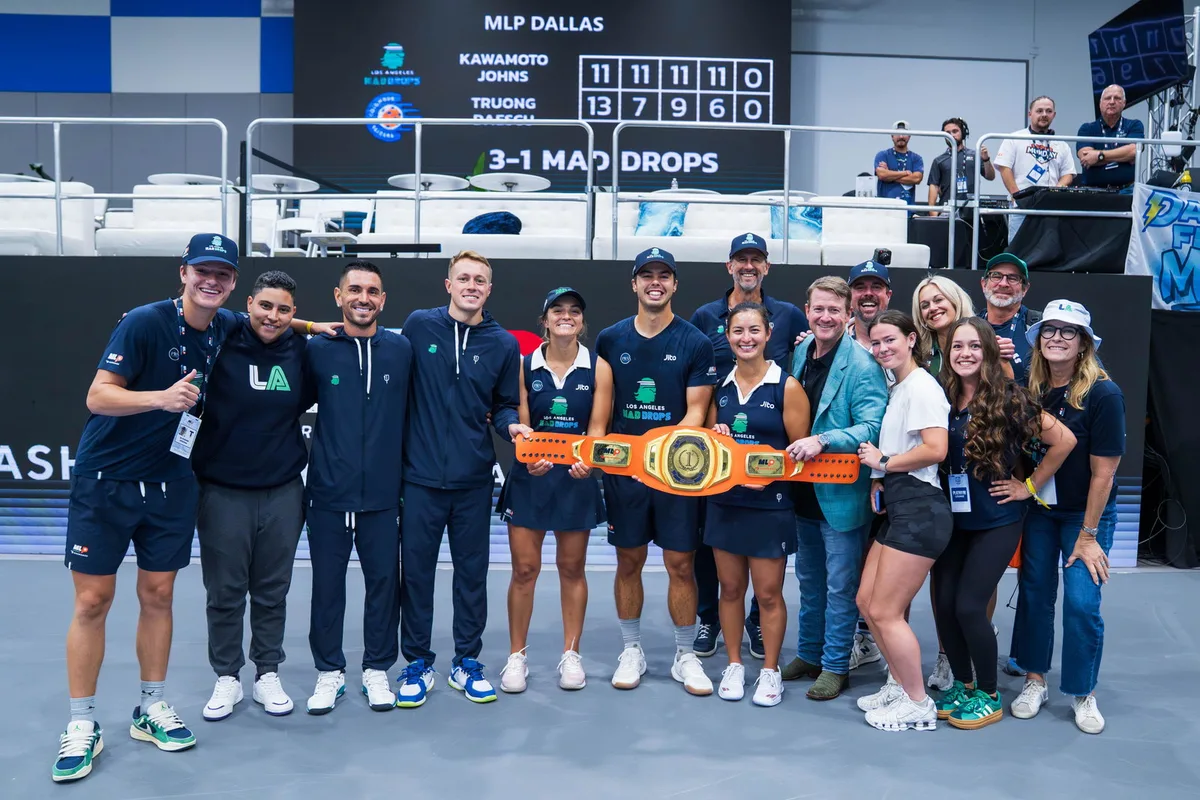
The Los Angeles Mad Drops with the Dallas event title belt. Their event win earned 25 season standings points. Photo credit: Major League Pickleball via Pickleball.com’s Dallas report.
Where Does the Mid-Season Tournament Fit?
The Mid-Season Tournament brings all franchises into a separate double-elimination bracket, meaning a team can survive an initial loss. In 2026 it also awarded bonus season points: 10 for the champion, six for second, and four for third, according to the competition document.
It therefore offers both an event trophy and a chance to improve playoff position. Winning this tournament and winning the season championship are separate achievements.
How Do the MLP Playoffs Work?
For 2026, the top 12 teams in season standings qualify. The top four receive first-round byes, so they begin in the quarterfinals. The postseason takes place over three event weekends, with the semifinals and finals sharing the last weekend. The league’s playoff overview outlines the route.
A playoff series is best of three team matches. Each match still contains the familiar doubles games and a possible DreamBreaker. Winning one doubles game does not win a series; a franchise must win two complete team matches to advance.
First Round: Seeds 5–12
Eight teams play four series. Seeds 5–8 choose opponents from seeds 9–12, with No. 5 choosing first and the other higher seeds following in order.
That choice is an unusual reward for regular-season performance. A higher seed can consider playing styles and lineup matchups when deciding whom to face. The four series winners advance and are reseeded for the next round based on regular-season standings points. The Dallas playoff guide confirms these rules.
Quarterfinals: The Top Four Enter
The four first-round survivors join the four teams that received byes. The No. 1 seed selects an opponent from the four survivors, followed by No. 2 and the remaining higher seeds. Four best-of-three series reduce the field to four semifinalists.
In 2026, this round was held in Newport Beach. The Newport Beach playoff guide contains the selection and advancement rules.
Semifinals and Finals: Decide the Champion
The highest remaining seed chooses its semifinal opponent from the two lowest remaining seeds. The other two teams form the second semifinal. Both semifinals are best-of-three series, and their winners meet in another best-of-three series for the championship. These rules appear in the league’s full postseason breakdown.
The 2026 championship weekend was held in New York City. A team that received a first-round bye needed three series wins to become champion; a team starting in the first round needed four.
| Round | Teams entering the round | What advances a team? |
|---|---|---|
| First round | 8; top four seeds sit out | Win two team matches |
| Quarterfinals | 8, including the four bye teams | Win two team matches |
| Semifinals | 4 | Win two team matches |
| Finals | 2 | Win two team matches to take the title |
Why Does Seeding Matter So Much?
A top-four finish removes an entire elimination series from a team’s path. Higher seeds also gain opponent-selection opportunities and lineup-response advantages under the playoff rules.
Those rewards give regular-season placement matches real weight. A few extra standings points can change whether a team gets a bye, whom it can choose, and how many series it must survive.
What Should You Watch for in an MLP Match?
Once you understand the format, follow three coaching questions:
- Which partnerships create the best chances? Watch how mixed doubles partners divide the middle, cover a teammate’s attack, and reset when a rally turns defensive.
- How does the score change the pressure? At 2–1, the trailing team must win the remaining doubles game. Notice whether players keep constructing points or begin forcing low-percentage attacks.
- Who can change the DreamBreaker? Watch the singles rotations. A player who loses a difficult segment narrowly can still help by handing a manageable score to the next teammate.
You can borrow those ideas for recreational play. Agree on middle-ball responsibility, communicate after errors, and build points with your partner. The professionals’ speed is difficult to copy; their habits are easier to practice.
How to Watch and Follow MLP
Start with the league’s event schedule for event pages and match information. Check each event’s broadcast details before watching; the Dallas playoff page lists Pickleballtv coverage and additional television windows for that event.
For replays and highlights, visit the official MLP YouTube channel. Choose one full team match so you can see how the doubles games connect. Following a favorite franchise makes the season standings and roster moves much easier to care about.
Frequently Asked Questions
How many players are on an MLP team?
In the U.S. league’s 2026 format, each team has six rostered players: three women and three men. Doubles games use two players per team, and a DreamBreaker uses one player per team at a time.
Are Premier and Challenger still MLP divisions?
They were discontinued for the U.S. league’s 2026 season, when all 20 teams competed at one level. The PPA Challenger Tour is a separate competition; its name does not indicate an MLP division.
Can anyone sign up for the MLP draft?
The 2026 professional player pool is restricted to UPA-contracted players. Becoming eligible and being selected by a franchise are separate steps. Amateur MiLP registration is a different process.
Does every MLP match include singles?
No. Singles appears in the DreamBreaker when the four doubles games finish 2–2. A team that wins three doubles games has secured the match without it.
Do individual rally points carry into the next game?
No. Each doubles game starts with a fresh score. The team match tracks games won. Inside a DreamBreaker, however, the shared tiebreaker score continues when players rotate.
Is winning an MLP event the same as winning the league?
No. A regular-season event awards an event title and standings points. The Mid-Season Tournament has its own title. The season championship goes to the winner of the playoff final series.
Your first full match gives all of this a practical shape: each partnership contributes to a shared result, every event builds the standings, and the playoffs test the roster through repeated matches under pressure. Pick a team, follow its four doubles games, and watch how its players respond when a teammate needs them.

Want Personalized Coaching?
Coach Pickle gives you an AI pickleball coach in your browser or on your phone. Get strategy advice, drills, and mental game coaching tailored to your skill level.