The Punch Volley at the Kitchen Line: Short Swing, Real Pressure
Learn how to hit a compact punch volley from the kitchen line, which balls to punch, where to aim it, and the mistakes that turn it into a pop-up or a fault.
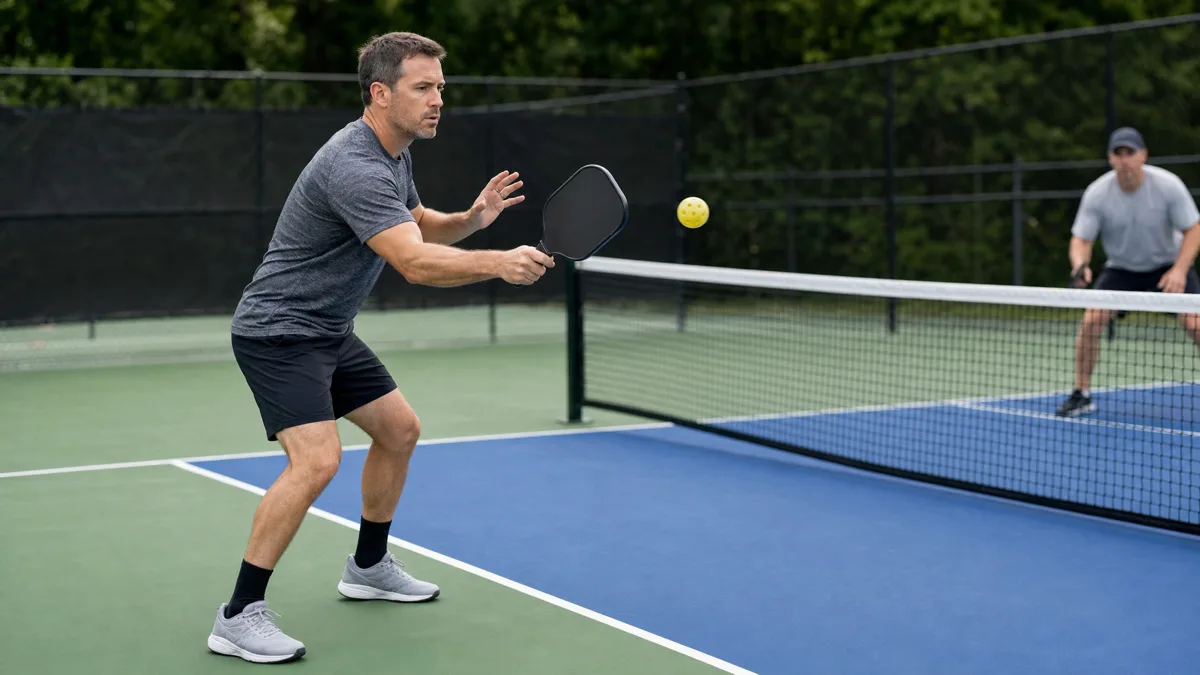
The punch volley is the shot that turns a slightly high ball at the kitchen line into pressure. It is short, firm, and fast to the target. You do not swing at it so much as meet it early and push through it. When it works, your opponent has less time to react than they would against a big swing, because there is no windup to read and the ball arrives on a flat, low path.
It is also the shot most intermediate players overhit. A punch that turns into a swing sails long, pops up, or carries your momentum into the kitchen. The goal of this guide is a punch that stays compact under pressure.
Which balls should you punch?
Punch a ball you can take out of the air, in front of your body, at roughly chest height. That height lets you hit level or slightly down without lifting the ball, so it stays low as it crosses the net.
Good punch opportunities:
- A dink that floats up. Your opponent misjudged the arc and the ball is rising toward your chest instead of dying in the kitchen.
- A soft, medium-height drive. The ball has some pace but sits up enough for you to meet it early.
- A reset that came back a little high. Not high enough to smash, but too high to let drop.
Do not punch a ball below the net tape. If you have to contact it low, a punch sends it up or into the net. Block it soft, dink it, or reset instead. And if the ball is above your head, that is an overhead, not a punch.
How to hit the punch volley
Start in a ready position. Feet about shoulder width, knees bent, weight on the balls of your feet. Paddle up and in front of your chest, roughly between your forehand and backhand so you can go either way. Stand behind the kitchen line, not on it.
Keep the elbow bent and in front of you. This is the whole shot. Your hitting elbow stays in front of your ribs at about a right angle, and the paddle sits about a forearm’s length ahead of your chest. If your arm is fully straight at contact, you reached instead of punched.
Meet the ball early, out in front. Move the paddle forward a short distance into the ball, like a jab. Contact happens in front of your body, not beside or behind it. The earlier you meet it, the less time your opponent has.
Firm wrist, square face. Keep the wrist quiet and slightly laid back. The paddle face should be square to your target or a touch closed for a ball above net height. Opening the face is how a punch becomes a pop-up.
Short finish, then reset. Stop the paddle a few inches past contact and bring it straight back to ready. A long follow-through is wasted time, and the ball often comes straight back.
A useful cue: “meet it, don’t swing at it.” The pace comes mostly from your forward body weight and a firm paddle, not from a backswing.
Where to aim the punch
Aim low and through, not up and over. The best punches cross the net with a little clearance and land at or past the opponent’s feet.
Their feet. A punch at the shoe tops forces an awkward low volley or half-volley. It is a high-percentage target because it gives you some margin above the net.
The paddle-side hip. A punch at an opponent’s right hip (for a right-hander) jams them. They have to choose forehand or backhand and get the paddle out of the way of their own body. Our guide to beating bangers covers the same target from the defensive side.
The middle. In doubles, a punch between the two opponents creates hesitation over who takes it. It also keeps the ball away from the sidelines, so you are not trading safety for angle.
Save sharp angles for balls that sit up a little higher. On an average punch, depth and the right body target beat width.
Common punch volley mistakes
Taking a backswing. Any backswing longer than a few inches costs you time and control. If you feel late, shorten the backswing further, don’t add to it.
Hitting up on the ball. If the ball is at or below the net, the punch is the wrong shot. Lifting it from there gives your opponent a ball to attack.
Leaning into the kitchen. You may not volley while touching the non-volley zone or its line, and your momentum after the shot cannot carry you in either. A big forward step on the punch is how players fault. Keep your base wide and let your upper body move forward instead of your feet. What is the kitchen? covers the full rule.
Punching everything. A punch on a ball that is too low or too far from your body is a gift. Patience in the dink rally is what earns the punchable ball. Our dinking strategy guide explains how to set it up.
A drill to build the punch
Wall punches (solo). Stand about 8 to 10 feet from a wall. Volley the ball continuously without letting it bounce, keeping every contact in front of your chest with a bent elbow. Count how many in a row you can hit with the paddle never going behind your body. Then alternate forehand and backhand.
Feed and punch (partner). One player feeds soft, chest-high balls from the opposite kitchen line. The hitter punches each ball to a target at the feeder’s feet. Score a point only if the ball lands low and in front of the feeder. Switch after 15 feeds.
Live punch or dink. Start a cooperative dink rally. Either player may punch any ball that rises above net height. Everything else must be dinked. This builds the decision as much as the technique, which is where most punch errors actually come from.
The short version
Punch balls that are chest high and in front of you. Keep the elbow bent, the wrist firm, and the swing short. Aim at the feet, the hip, or the middle. And stay behind the line. When the ball is lower than that, keep dinking and wait for the one that sits up.
Want Personalized Coaching?
Coach Pickle gives you an AI pickleball coach in your browser or on your phone. Get strategy advice, drills, and mental game coaching tailored to your skill level.