Pickleball drives: use pace with purpose
Build controlled forehand and backhand drives, choose useful targets, and learn when pace creates an opening or gives the opponent an easy counter.
By Coach Pickle coaching team · Last updated
What a drive should achieve
A drive is a firm groundstroke designed to pressure an opponent through pace, placement, or a dipping trajectory. It may win outright, but more often its value is the reply it creates: a high block, a short ball, or a contact that slows the opponent’s advance.
Driving every ball removes that purpose. A well-positioned player at the kitchen using compact volleys can redirect predictable pace with a short volley. Learn to ask “what next ball am I trying to create?” before asking “how hard can I hit?”
Build stable contact first
Move into position early and create enough space for the swing. Turn your torso to prepare, keep the backswing proportional to the time available, and contact in front of your body. Use the legs and trunk to support the motion rather than making the wrist do all the work.
For a forehand, allow a smooth forward swing and a finish that follows the intended path. For a backhand, prepare the shoulders early and choose a one- or two-handed technique you can reproduce comfortably. There is no requirement to use the same backswing or finish on both sides.
Start at a pace that lets you hold balance. If you fall sideways or cannot recover the paddle after contact, the shot is too ambitious for your current spacing. Accuracy at moderate speed is the foundation for useful power.
Add topspin without scooping
Topspin comes from brushing upward through contact with an appropriate paddle path and face. It can help a firm ball dip into the court. It does not rescue a badly aimed shot automatically.
Beginners sometimes open the face dramatically and scoop under the ball, producing height without the desired forward pressure. Others roll the wrist abruptly and lose control of direction. Practice a smooth low-to-high path while maintaining clean contact, then increase pace gradually. Watch the flight and bounce instead of judging spin by the appearance of the finish.
Choose the right ball
A ball that sits up with space in front of you is a better driving opportunity than a low ball at your feet. A shorter return may let you contact nearer the court and pressure the opponents before they settle. A deep return that forces you backward usually calls for more margin and a less aggressive decision.
Against two ready opponents at the kitchen, your drive must have a purpose. Can it dip toward their feet? Can it pressure a vulnerable backhand? If it travels high through a comfortable strike zone, their position may matter more than your speed.
Use placement before extra power
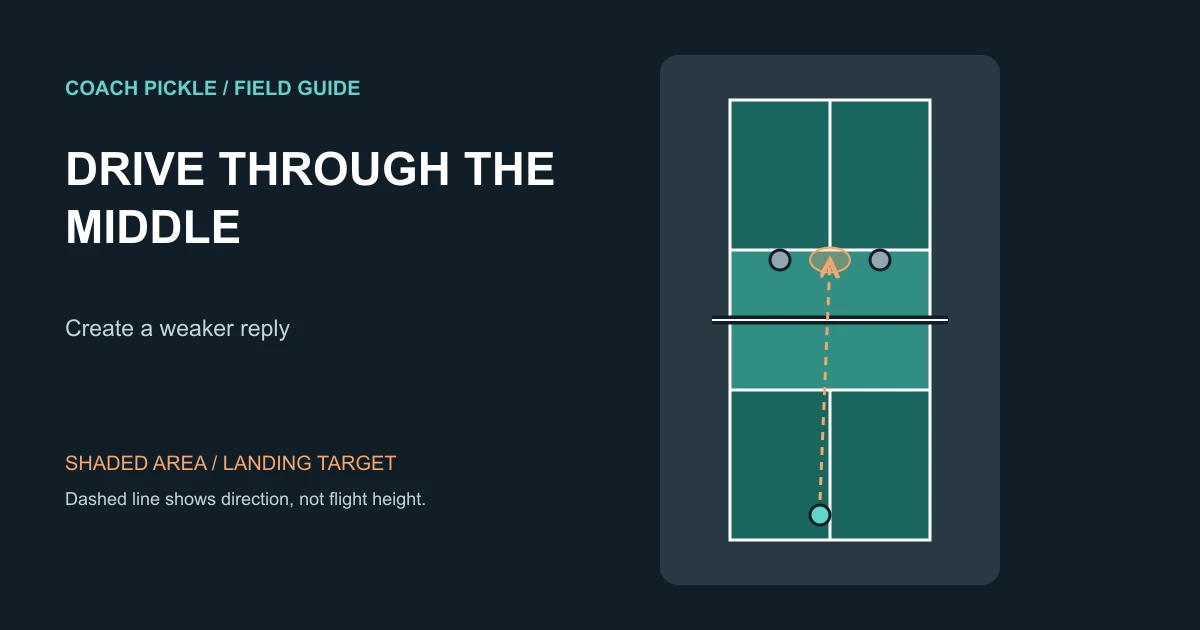
A middle drive offers margin and can create hesitation between partners. A body target can crowd a prepared swing. A dipping ball toward the feet is difficult to volley aggressively. A sideline pass has a smaller target and is more useful when the opponent’s position actually leaves that lane open.
Consider who will handle the reply. If you drive crosscourt and your partner is exposed to a sharp counter, talk about positioning. An aggressive shot is a team decision in doubles because the next ball may go to the other player.
Connect the drive to the next shot
Stay back for the required return bounce when you are serving. After a third-shot drive, recover your paddle and read the block. A soft, short reply may invite a fifth-shot drop and an approach. A firm counter may require another balanced groundstroke or reset.
Do not automatically sprint forward behind a drive. Pace reduces your reaction time too. Move when the reply gives you time, and stop when the opponent prepares to contact. Mixing drives and drops makes both more effective than using either without regard to the rally.
Fix common misses
Long balls: reduce pace, inspect face angle, and restore contact in front. Do not aim closer to the net as your only correction.
Net balls: you may be flattening a low contact too much. Add clearance or choose a drop when the ball does not support an attack.
Easy opponent counters: inspect the target and trajectory. More speed through the same comfortable contact zone may make their job easier.
Late backhands: prepare earlier and shorten the swing against pace. Timing and space come before power.
Practice pressure rather than winners
Hit ten forehands and ten backhands into a broad deep target at moderate pace. Record balls in before increasing speed. Next, ask a partner at the kitchen to block controlled drives; score a success when your shot produces a low or awkward reply, not only when it passes them.
Finally, play a drive-block-drop sequence. Drive the first feed, soften the next manageable block, and advance from balance. This teaches the drive as part of a rally plan. If the block is too fast or deep to drop comfortably, keep the ball playable and restart rather than forcing the planned pattern.
Frequently asked questions
What is a drive in pickleball?
When should you drive instead of drop?
How do you hit topspin on a pickleball drive?
Where should you aim a pickleball drive?
Practice drives with Coach Pickle
Download Coach Pickle for personalized shot-selection advice, drive practice plans, and drills that connect your attacking shot to the next ball.