Pickleball volleys: block, punch, and counter with control
Learn compact net-play mechanics, defend drives, attack higher balls, and stay legal around the kitchen line.
By Coach Pickle coaching team · Last updated
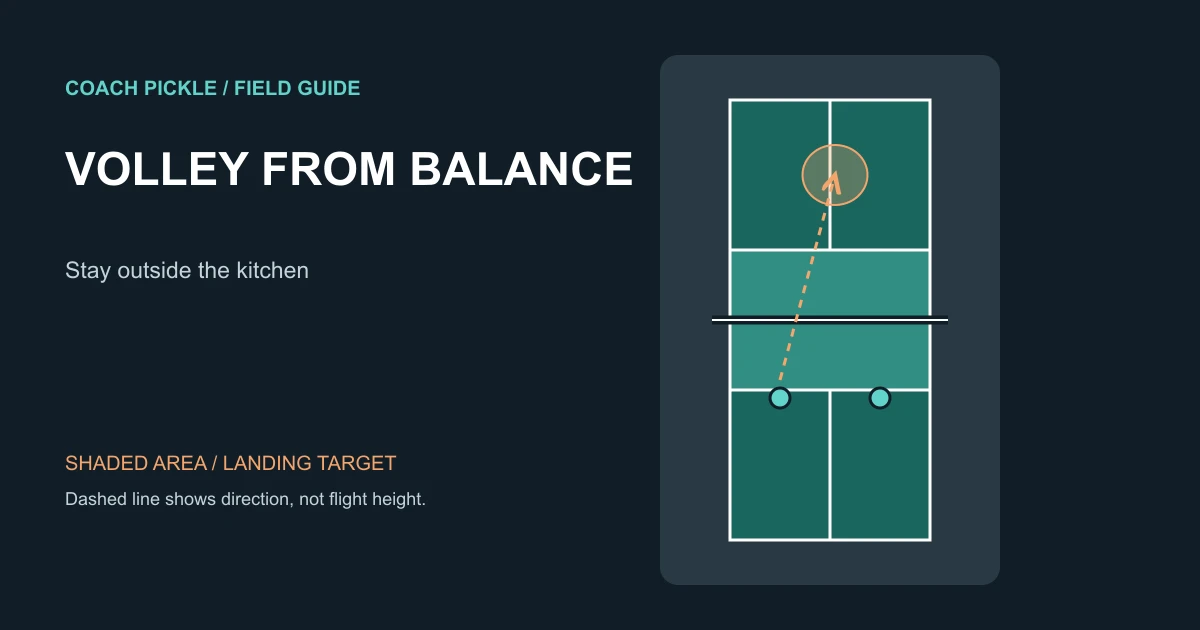
A volley is a timing advantage
A volley hits the ball before it bounces. Near the kitchen line, that takes time away from the opponent and helps your team hold court position. The shot can be defensive, neutral, or attacking; “volley” does not mean you must hit hard.
The two-bounce rule still applies: the serve and return must each bounce before anyone volleys. You must also be outside the kitchen for a legal volley, and your volley momentum cannot carry you into it. Review the official rules when learning these boundaries.
Establish a ready position
Stand with a balanced base, knees softly bent, and the paddle in front where you can cover both sides. Keep elbows comfortably away from your body rather than pinning them back. Your exact paddle height should fit the incoming threat: higher against a likely speed-up, lower when expecting a dipping ball.
Prepare before the opponent contacts. Track their paddle and body as well as the ball. A ready paddle and short movement usually beat a late, large swing even when the latter looks more powerful.
Three useful volley responses
Block: against fast pace, use a stable face and little added swing. The ball already has energy. Direct it toward a safe target and recover.
Punch: against a manageable ball, add a compact forward motion to create controlled pressure. Contact in front and avoid a sweeping follow-through.
Counter: when an opponent speeds up and you have comfortable spacing, redirect or add pace with a short stroke. A counter should leave your paddle ready for another exchange.
Low balls may need a softer lifting response or a reset. Higher balls can support a firmer downward angle. Trying to punch every low volley is a common source of net misses.
Let height decide your ambition
Contact below net height requires lifting the ball over the net. That makes a hard downward attack unavailable. Prioritize clearance and a target that denies the opponent an easy next shot.
Contact above the net gives more attacking options, but you still need balance and space. A high ball jammed against your body may be less attackable than a slightly lower ball comfortably in front. Choose the stroke you can control at the actual contact point.
Defend the body and middle
Many fast exchanges arrive near the torso. A backhand-oriented block can cover a useful portion of the body for many players, but do not freeze into one position for every ball. Move the paddle compactly and create space with a small foot adjustment when time permits.
With your partner, agree on who covers shared middle balls in common situations. “Forehand takes the middle” can be a helpful starting agreement, but handedness, balance, and who is already prepared matter. Call early rather than letting a slogan override the player with the easier contact.
Keep your balance outside the kitchen
Leave enough room behind the line that your usual volley movement does not carry you over it. On a reaching volley, control the follow-through and regain balance. If you stepped into the kitchen for a bouncing ball, establish both feet outside before volleying again.
Do not lean farther and farther over the line chasing a ball you cannot control. When appropriate, let it bounce and play from inside the kitchen. Taking time away is useful only if the contact and recovery remain sound.
Mistakes that give away easy balls
A big backswing uses time you do not have and often sends balls long. A tight grip can make a defensive block rebound too strongly. Contact beside or behind the body reduces control. Watching your shot instead of recovering the paddle leaves you late for the next exchange.
Pick the failure that happens most often and work on it specifically. For example, if hard drives rebound long, start with shorter blocks and a softer hand before changing your stance or target.
A safe practice progression
Begin with gentle cooperative volleys from outside the kitchen, keeping feeds controlled. Aim for ten exchanges with compact strokes and ready-paddle recovery. Next, one player feeds moderate drives while the other blocks into a broad target.
Then vary high and low feeds. The volleyer names the choice—block, punch, or reset—and uses the corresponding pace. Finish with live kitchen rallies where both players start with dinks and speed up only from a manageable ball. Record long blocks, net misses, and contacts that caught you unprepared. Those categories point to different fixes.
Frequently asked questions
What is a volley in pickleball?
When can you volley in pickleball?
How do you block a hard pickleball drive?
Should you attack a low volley?
Practice volleys with Coach Pickle
Download Coach Pickle for volley drills and personalized net-play advice. Pro subscribers can use supported volley drill video analysis to work on technique.