Pickleball dinks: control the rally at the kitchen
Learn soft-shot mechanics, crosscourt and straight dinks, purposeful placement, and how to recognize an attackable ball.
By Coach Pickle coaching team · Last updated
What a dink is for
A dink is a controlled shot, usually played near the kitchen line after a bounce, that lands in the opponent’s kitchen. Its purpose is to keep contact low, deny an easy attack, and move the opponent until you earn a better ball. It is not merely a slow shot or a promise to keep the rally soft forever.
A useful dink makes the opponent adjust without giving them a comfortable contact above net height. Depth, width, height, and pace all influence that result. A ball that lands in the kitchen can still be attackable if it sits up high enough.
Create the shot with your body
Start balanced with knees softly bent and the paddle in front. Use your feet to find space before contact. A compact motion with a quiet wrist is easier to control than a wrist flick that changes the face at the last moment.
Contact in front, with the paddle face slightly open as needed to lift the ball. Use a small shoulder-led swing and gentle support from the legs. The follow-through should match the distance; it should not resemble a drive finish. Stay low through contact rather than standing abruptly and launching the ball upward.
Grip pressure should be relaxed enough for feel but firm enough that the paddle face stays stable. “Soft hands” does not mean a loose paddle that twists unpredictably. Let your partner feed a few balls while you experiment with less squeezing and a smaller swing.
Move to the ball without losing the line
Use short lateral steps for nearby balls. If the ball lands short, enter the kitchen to play the bounce, then recover before your next volley. Reaching from outside the zone can turn an easy dink into a weak pop-up.
Keep your recovery proportional to the shot. After a wide dink, move back toward a position that protects the next likely angle. Your partner should shift with you so the middle does not become a large gap. Avoid getting so focused on the ball that you forget the space between you.
Crosscourt or straight ahead?
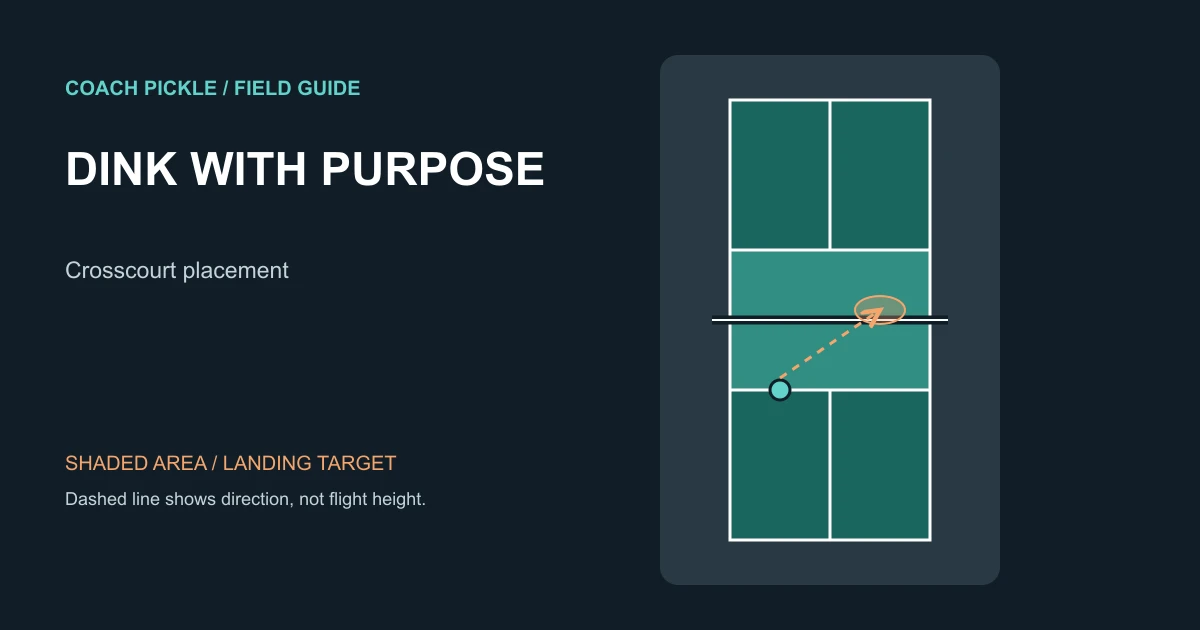
Crosscourt dinks travel over a lower part of the net and have more court length available. They are a useful starting pattern for learning control. They can also move an opponent wider and create space through the middle.
Straight dinks change the pattern and can pressure the player directly opposite you. Because the distance is shorter, excess height or pace may be easier to attack. A middle dink can reduce angles and help your team recover. Choose a target that suits your balance and the opponent’s position, not just the most ambitious opening.
Start by keeping neutral dinks safely low. Once you can do that, add placement that makes the opponent move. Do not add severe angles or heavy spin before you can control a simple ball under pressure.
Decide whether to stay soft or attack
If contact is below the top of the net and you are stretched or off balance, a controlled dink or reset under pressure is often the higher-percentage choice. A higher ball with stable spacing can permit a speed-up, but the opponent’s paddle readiness and your ability to handle the counter matter too.
Watch the opponent’s contact rather than only the bounce. Are they reaching, backing up, or contacting from below the net? Those are signs your placement created pressure. If they are comfortable, change location gradually instead of forcing a winner from a low ball.
Diagnose common errors
Pop-ups: check for a wrist flick, too much swing, or rising legs. Reduce the motion and keep the face consistent.
Net misses: you may be closing the face or trying to skim the tape. Give yourself more clearance while keeping the landing short.
Wide misses: shrink the target away from the sideline. Wide placement is useful only when the ball stays in.
Late reaches: move your feet sooner and prepare the paddle before the bounce. Technique cannot fully compensate for poor spacing.
Build a purposeful practice progression
Begin with cooperative straight dinks and aim for ten consecutive controlled exchanges. Then switch to crosscourt and count balls that require your partner to contact below net height. Reset after a pop-up so you can discuss what changed.
Next, alternate middle and wide targets with generous margins. Finish by allowing an attack only when the hitter is balanced and sees a higher ball. That final stage teaches recognition rather than automatic speeding up. Track unforced misses and attackable pop-ups separately: a rally can continue even when a dink gave away the advantage.
Frequently asked questions
What is a dink in pickleball?
Can you stand in the kitchen to dink?
Why do my dinks pop up?
Should you dink crosscourt or straight ahead?
Practice dinks with Coach Pickle
Download Coach Pickle for dinking drills and personalized soft-game advice. Pro subscribers can review supported dink drill videos to identify technique improvements.