Pickleball drops: turn a deep ball into a chance to advance
Learn the third-shot drop, trajectory and landing targets, when to choose a drive instead, and how to approach behind a successful drop.
By Coach Pickle coaching team · Last updated
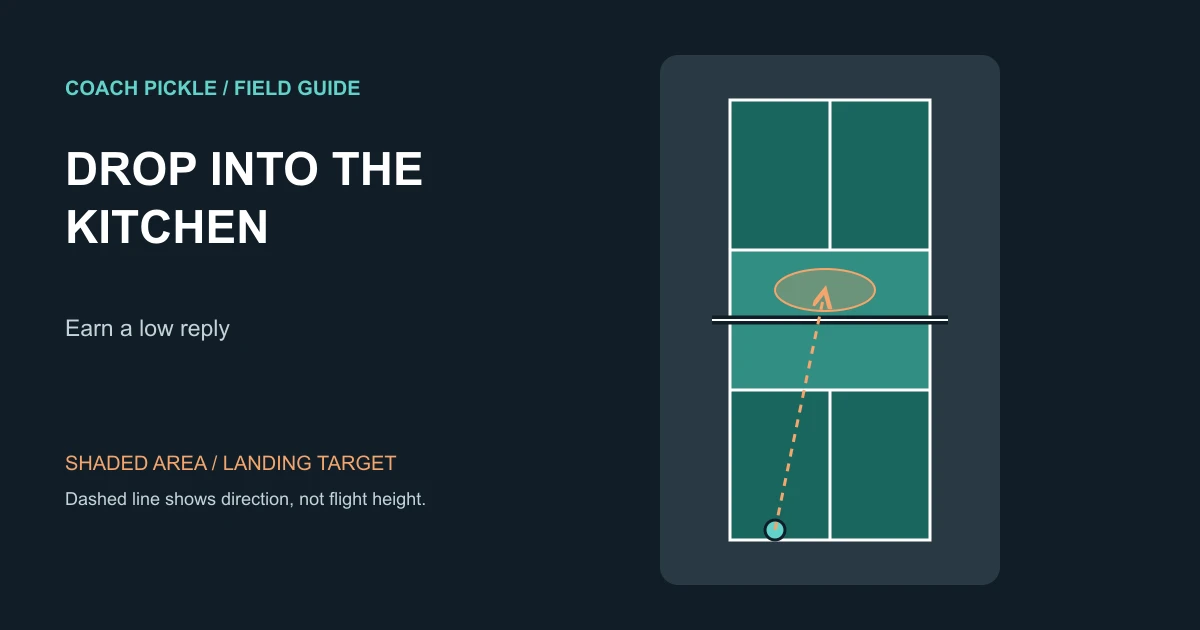
What a drop changes
A drop is a soft shot played from farther back in the court that lands in or near the opposing kitchen and makes the next contact difficult to attack. The third-shot drop is the serving team’s version after the return, but you can use a drop later in a rally too.
Its job is to reduce the advantage of opponents already at the kitchen and create time to advance. It does not guarantee you can run straight to the line. A drop that sits high may require you to stay back and defend another ball.
Drop, dink, and reset are related
A dink usually starts near the kitchen. A drop usually travels from deeper in the court. A reset commonly absorbs pressure and returns the rally to a softer exchange. They share control and lift, but the incoming pace and required distance change the stroke.
A beginner often tries to use a tiny kitchen dink swing from the baseline. That can land in the net because the distance is much greater. A drop needs enough smooth lift and forward energy to cover the court without becoming a floating invitation to attack.
Shape the trajectory
Prepare early, get behind the bounce, and contact in front with a slightly open paddle face. Use a controlled low-to-high motion supported by the legs. Keep the grip comfortable and the wrist relatively quiet. Your goal is a ball that rises enough to clear the net and descends into the target area.
Think of an arc, not a straight line aimed at the kitchen. Trying to hit a very low laser leaves little margin. On the other hand, a ball that remains high as it reaches the opponent can be volleyed aggressively. Judge the flight at their contact point, not just where it would have landed.
From a deeper position, you generally need more lift and length than from midcourt. Practice from shorter distances first so you can feel the required adjustment. Wind, ball type, and incoming spin change the bounce; avoid treating one swing size as universal.
Choose forgiving targets
A central kitchen target gives margin from both sidelines and can reduce attacking angles. Crosscourt provides more distance and a lower net crossing, but it can expose a partner if the opponent attacks a high ball. A target toward a weaker volleyer may be useful once you can control the shot.
Do not demand that every drop barely cross the tape. A modest margin produces more playable balls while you learn. Measure success by whether the opponent must contact low or let the ball bounce, rather than declaring every kitchen landing a perfect drop.
Know when a drive is reasonable
A short, higher return may offer a comfortable drive. A deep return that leaves you low and balanced may favor a drop. If you are rushed or stretched, first choose a shot you can keep in and recover behind.
A drive followed by a softer fifth shot is a legitimate sequence. The drive may produce a less demanding block, which is easier to drop than the original return. The decision should follow the ball you received, rather than a rule that all third shots must be soft.
Advance according to the response
After contact, read your drop. If it forces a low reply, move forward with your partner. Stop and establish balance around the opponent’s next contact. If the drop is high, prepare to defend instead of continuing your run into an attack.
You may need several shots to reach the kitchen. A good fifth or seventh shot can finish the job the third shot started. The transition area is a place to make decisions, not a place to panic because you did not arrive immediately.
Common errors and corrections
A net miss can come from insufficient lift or contact too far behind you. A high, long drop can come from excess swing or opening the face as you stand up. A sideways miss often starts with poor spacing. Change one variable, then repeat enough balls to see whether it helped.
Practice from close to far
Begin a few steps behind the kitchen while your partner feeds gentle bouncing balls. Hit ten drops to a broad kitchen target. Move back when most balls produce low opponent contacts, then repeat from midcourt and the baseline.
Next, have your partner alternate deep and short feeds so you adjust the swing instead of repeating identical balls. Finish with serve-return-third-shot sequences and continue through the fifth shot. Count playable drops, attackable balls, and successful balanced advances separately. That tells you whether the problem is the stroke, shot selection, or movement after it.
Frequently asked questions
What is a third-shot drop in pickleball?
Where should a third-shot drop land?
Should you always hit a third-shot drop?
How do you practice a third-shot drop?
Practice drops with Coach Pickle
Download Coach Pickle to get a drop-shot practice progression and coaching advice for your third-shot decisions. Pro subscribers can use supported drop drill video analysis.