Pickleball resets: absorb pressure and regain control
Learn how to soften hard balls, defend in the transition zone, choose safe reset targets, and recognize when the rally is neutral again.
By Coach Pickle coaching team · Last updated
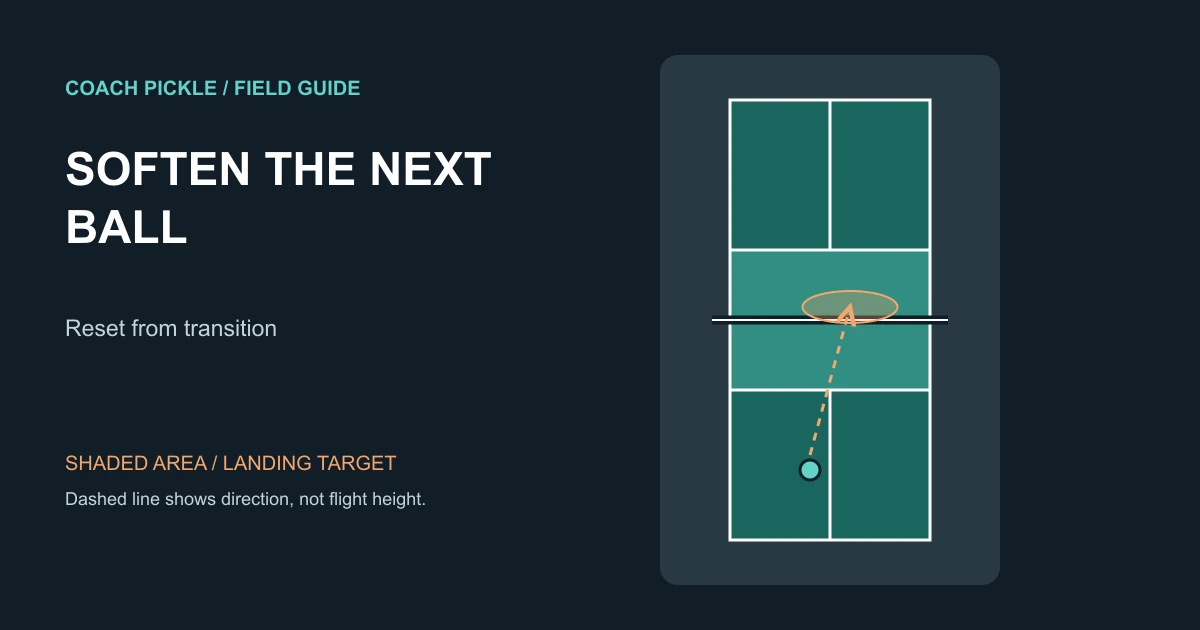
What a reset really does
A reset turns an attacking or uncomfortable incoming ball into a softer reply that limits the opponent’s next attack. Often the target is the kitchen, where a low bounce can give you time to recover or advance. You are trying to change the rally’s pace and position, not merely slow down your swing.
Resets can be played off a bounce, as a half-volley shortly after the bounce, or out of the air. A volley reset still follows the kitchen rules. The term describes the tactical purpose; it does not require one exact stroke.
Recognize when defense is the better choice
A hard ball at your feet, a low contact in the transition area, or a speed-up that catches you stretched is often a reset opportunity. Driving upward from that position can give the opponent a higher ball to attack. A reset aims to keep the rally alive until your team has better balance.
Not every fast ball needs a reset. If you have a stable contact above net height and space for a compact counter, attacking may be reasonable. Let contact height, spacing, and the opponent’s position guide you. Avoid deciding to reset before seeing what arrives.
Absorb pace with a stable paddle
Get low through your legs, place the paddle in front, and prepare a small motion. Use relaxed but stable grip pressure. Against a hard ball, the incoming speed supplies much of the energy; adding a backswing often sends the reply long or high.
The paddle face usually needs some openness to lift a low ball. Keep it controlled through contact rather than opening it abruptly. Think of receiving the ball on a stable platform and guiding it over the net. “Soft hands” means managing rebound, not letting the paddle collapse.
For a volley reset, meet the ball in front with minimal forward punch. For a bouncing reset, watch the bounce and use a short lifting motion. For a half-volley, stay especially quiet because the ball is rising quickly and the timing window is small. If you have time to allow a fuller bounce, you do not need to force a half-volley.
Your feet determine your options
In the transition area, settle before the opponent’s contact. A balanced split step leaves you ready to lower, move sideways, or adjust back. Running forward as a drive arrives at your feet makes touch much harder.
After you reset, watch its quality. A low reply that makes the opponent contact upward may allow a step forward. A floating reply requires you to hold or prepare for another attack. Advance in stages with your partner instead of treating one soft contact as permission to charge the kitchen.
Use generous targets
The middle of the kitchen is a useful first target because it provides sideline margin and limits some angles. Crosscourt can offer more distance, but it also asks for more directional control under pressure. When stretched, choose the target you can reach with the smallest reliable adjustment.
A reset does not need to die just over the net. It needs to reduce the opponent’s attacking options. A slightly deeper soft ball may still be useful if their contact stays low. Conversely, a kitchen landing is not a success if they could have volleyed it high and hard.
Troubleshoot the common failures
The ball pops up: reduce your forward motion and grip squeeze. Check whether the face opened suddenly or your body rose at contact.
The ball dies in the net: you may have absorbed too much energy or provided too little lift. Use a touch more face openness or leg support without adding a big swing.
You reset well from feeds but fail in games: vary the feeds and practice stopping first. Predictable balls can hide late preparation.
You get attacked again: that may be normal. One reset is not always enough. Evaluate whether the reply reduced pressure and whether you recovered for the next ball.
Practice from predictable to live
Have a partner feed gentle balls from the kitchen while you stand in midcourt. Reset ten bouncing balls to a broad kitchen target. Then practice ten controlled volley resets from outside the kitchen. Ask for gradual increases in pace, not full-speed blasts at close range.
Next, alternate feeds to your forehand, backhand, and feet. Count resets that force a low reply and note pop-ups separately. Finish a cooperative transition drill: start back, play a drop, reset any manageable attack, and advance only behind a low response. Switch roles so each player learns what makes a reset hard to attack.
Know when you have regained control
You have neutralized the rally when you are balanced and the opponent no longer has an obvious downward attack. That may happen before you reach the kitchen. Take the next sound shot from that position rather than immediately trying to recover the point with a winner. Defense succeeds when it gives you choices again.
Frequently asked questions
What is a reset in pickleball?
What is the difference between a drop and a reset?
Can you hit a reset without letting the ball bounce?
Why do my resets pop up?
Practice resets with Coach Pickle
Download Coach Pickle for reset drills and a practice plan built around the pressure balls you struggle with. Ask your AI coach how to connect defense, recovery, and your next shot.