Pickleball rules and scoring: a practical beginner guide
Understand the kitchen, two-bounce rule, line calls, and traditional doubles scoring so you can play your first game with confidence.
By Coach Pickle coaching team · Last updated
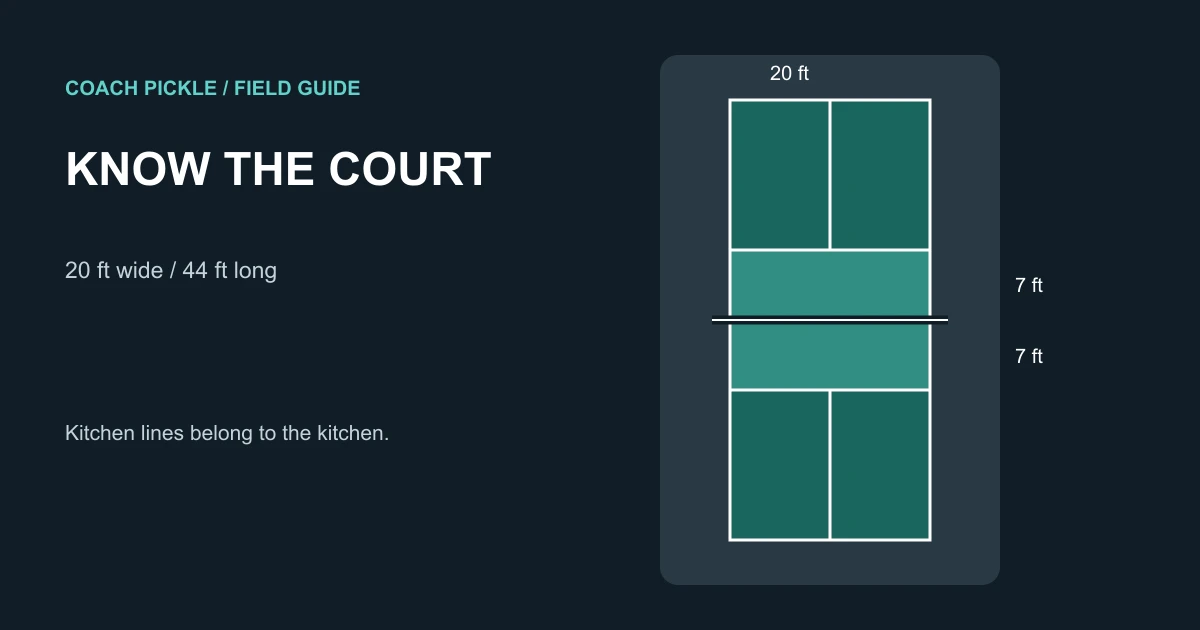
Understand the court and the goal
Pickleball uses a 20-by-44-foot court for singles and doubles. A net divides it in half, and a seven-foot non-volley zone, commonly called the kitchen, sits on each side of the net. Behind each kitchen, the centerline separates the right and left service courts. Your job is to return the ball over the net into the opposing court before it bounces twice.
Most recreational doubles games use traditional side-out scoring: only the serving team scores, games commonly go to 11, and you usually must win by two. Rally scoring and tournament formats can differ. Agree on the format before starting rather than assuming every game uses the same procedure.
Start a rally correctly
Serve from behind the baseline into the diagonal service court. The serve must clear the kitchen and its line. A serve on the correct service court’s baseline, sideline, or centerline is in; a serve on the kitchen line is a fault. A serve that touches the net and otherwise lands legally remains playable under standard USA Pickleball rules.
The receiver must let the serve bounce. The serving team must then let the return bounce. These are the two required bounces, one on each side. Once they happen, either team may volley, meaning hit before the bounce, subject to the kitchen rules. The serving team should therefore stay back to receive the return rather than charge the net immediately.
What the kitchen rule actually means
The kitchen restricts volleys, not entry. You may step into it to hit a ball that has bounced. You may also stay there, but you cannot volley until both feet have re-established contact outside the zone. The kitchen line belongs to the kitchen.
If you volley and your momentum carries you into the kitchen, that is a fault even if the ball is already dead. This includes contact by something you are wearing or carrying. Think of the volley as the stroke plus the movement it creates, rather than only the instant the paddle touches the ball.
A common beginner mistake is waiting outside the kitchen for a short ball to bounce again. Enter promptly, play a dink after its first bounce, and recover outside the zone before attempting a volley.
Read a doubles score
In traditional doubles scoring, the call has three numbers: your team’s score, the receiving team’s score, and the current server number. At 4–2–1, the serving team has four points, the receiving team has two, and the first server of that service turn is serving. The server number describes the turn, not a permanent player identity.
Normally both teammates get a service turn before a side out. The exception is the opening service turn of the game, when only one player serves. That is why the conventional opening call is 0–0–2. When the serving team wins a rally, it scores and the server switches service courts. When the first server loses a rally, the partner serves; when the second server loses, service passes to the other team.
For a simple opening example: call 0–0–2 and serve from the right. Win the rally and call 1–0–2 from the left. Lose the next rally and the opponents begin their turn at 0–1–1 from the right. Receiving players do not swap sides just because they win a rally while receiving.
Recognize faults and make fair calls
Common faults include hitting out, hitting into the net, allowing a second bounce, volleying a required bounce, and committing a kitchen volley fault. During ordinary rallies, a ball touching a boundary line is in. Call a ball out only when you clearly see it outside the line; uncertainty favors the opponent. Make calls promptly rather than after seeing how the rally develops.
In singles, traditional scores use two numbers. The server serves from the right when their own score is even and from the left when it is odd. Doubles positioning is more involved, especially with stacking, so learn ordinary service order first.
Practice before keeping a competitive score
Play five cooperative rallies in which you say “serve bounce” and “return bounce” aloud. Then play a short game to five, calling the full score before every serve. Pause after each side out to identify the next server and receiving position. Finally, feed short balls into the kitchen and practice stepping in, returning the bounce, and recovering outside it.
Your first goal is smooth restarts and correct positions, not speed. When a disagreement arises, consult the rulebook together. This guide describes standard recreational play, not every officiating exception or competition format.
Official rules reference
Check the USA Pickleball official rulebook for the current governing rules and format-specific details. Coaching recommendations elsewhere in these guides describe tactical choices, not additional rules.
Frequently asked questions
What is the two-bounce rule in pickleball?
Can you step into the kitchen in pickleball?
Why does pickleball doubles start at 0–0–2?
Is a ball on the line in or out in pickleball?
Practice rules and scoring with Coach Pickle
Download Coach Pickle to ask rules questions in plain language and get beginner drills and coaching advice suited to your experience.