Pickleball serves: build a reliable start to every point
Learn legal serving fundamentals, repeatable mechanics, depth and placement, and a progression from consistent serves to purposeful pressure.
By Coach Pickle coaching team · Last updated
What a good serve accomplishes
A serve starts the rally and can make the receiver’s next shot less comfortable. The first priority is putting it in. The second is depth: a deeper serve often keeps the receiver back and makes the return harder to attack. Pace and spin become useful only when you can reproduce them without giving away too many faults.
A serve does not need to be an ace to succeed. If it produces a shorter return or delays the receiver’s approach to the kitchen, it has helped your team. Judge it by the next ball as well as by whether the receiver touches it.
Know the two serving methods
For a volley serve, strike the ball before it bounces. Standard USA Pickleball requirements include an upward arm motion, contact no higher than the waist, and a paddle head that is not above the highest part of the wrist at contact. A drop serve is struck after a freely released ball bounces; the volley-serve motion restrictions do not apply, but you cannot throw the ball down or propel it upward to create the bounce.
At contact, at least one foot must be grounded behind the baseline; grounded feet must stay within the imaginary extensions of the sideline and centerline and must not touch the court. Serve diagonally beyond the kitchen line into the correct service court. Check the official rulebook for the complete release, foot-position, and service requirements.
Choose the method whose contact you repeat most comfortably. A drop serve is a useful option for players who prefer a visible bounce and more time to organize the swing. It is not a lesser version of the shot.
Build a repeatable motion
- Set a balanced stance behind the baseline with enough space to swing freely.
- Pick a broad target before moving. Start several feet inside the baseline and sidelines.
- Release the ball to a consistent location slightly in front of your body. Avoid reaching sideways to rescue an inconsistent release.
- Swing smoothly through contact using your legs and torso as support. Keep your head quiet and watch the contact area.
- Finish toward the target and recover behind the baseline for the return’s required bounce.
Begin with a comfortable forehand grip and a relaxed hand. A huge backswing adds timing demands without automatically adding useful depth. The best early cue is often “same release, same contact,” rather than “hit harder.”
Add depth before chasing the corners
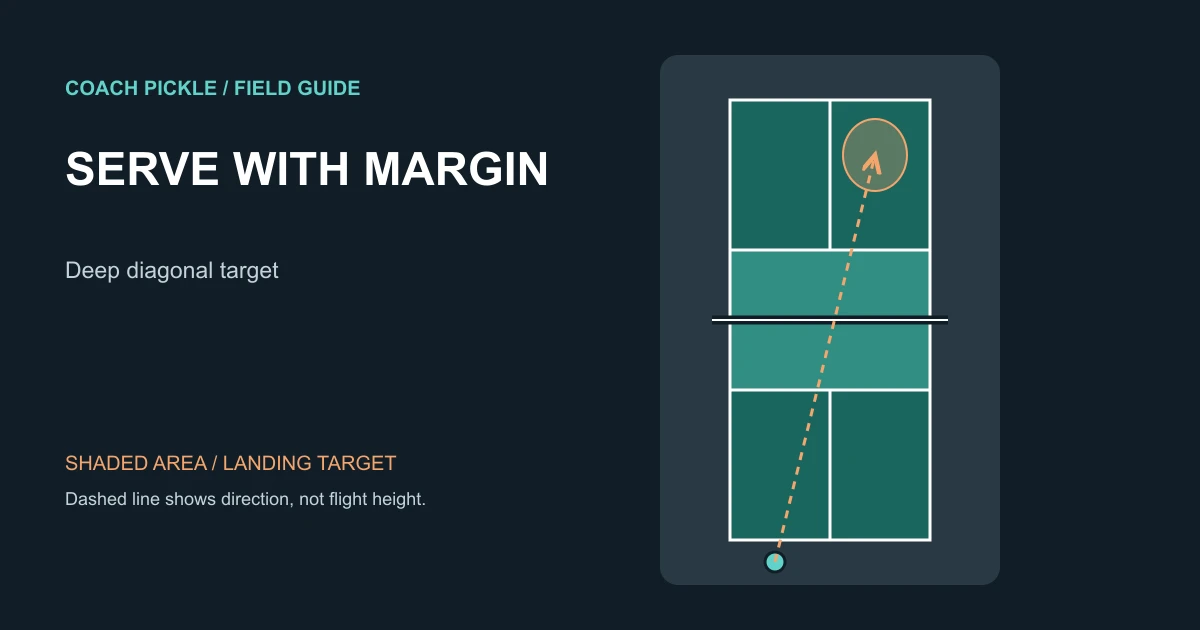
Imagine a large landing zone in the back portion of the diagonal service box. A target inside the lines gives room for small errors. Increase depth with a smoother, fuller swing or a little more arc; do not change five parts of the motion at once.
Once that target is reliable, try serving toward the receiver’s backhand or body. A body serve can limit their swing space. A wide serve can move them, but it also reduces your margin and can open an angled return. Watch what happens, then choose placement deliberately instead of always serving to the same presumed weakness.
Topspin can help a faster ball dip into the court. Develop it after you have dependable contact. Avoid confusing legal paddle-generated spin with adding spin during the release.
Fix the misses you actually see
Into the net: inspect contact height, paddle angle, and whether you are steering down. Give the ball more clearance before adding pace.
Long: reduce swing speed slightly or use a less open face. Keep the release consistent so you know which adjustment changed the result.
Wide: check whether the ball is too far from your body or your finish is crossing the intended line. Aim at a larger central target while restoring contact.
Good in drills, unreliable in games: use a short pre-serve routine: score, target, breath, release. Pressure often changes tempo before it changes ability.
A three-stage practice session
First, hit 20 serves at comfortable pace, ten from each side. Count legal serves in. Next, hit 20 toward a deep target and record both legal serves and target hits. Finally, play serve-return rallies with a third-shot drop so you learn to recover for the return rather than admire the serve.
Use a practical progression goal such as eight legal serves out of ten on both sides before shrinking the target. That is a training benchmark, not a rating standard. If accuracy falls sharply when adding speed, return to the previous pace.
Your game-day decision
At a tense score, use the serve you have practiced most. After a few rallies, notice whether the receiver struggles with depth, body placement, or a particular side. Make one adjustment and assess the next return. A reliable serve with a clear purpose is more valuable than a spectacular motion you cannot repeat.
Frequently asked questions
Can you serve overhand in pickleball?
Can a pickleball serve hit the kitchen line?
Can you bounce the ball before serving?
Where should you aim a pickleball serve?
Practice serves with Coach Pickle
Download Coach Pickle for serving drills, personalized practice plans, and help choosing one technique cue at a time. Pro subscribers can also use supported serve drill video analysis.