Pickleball returns: earn time to reach the kitchen
Learn how to return deep, choose safe targets, handle faster serves, and move forward while staying balanced for the third shot.
By Coach Pickle coaching team · Last updated
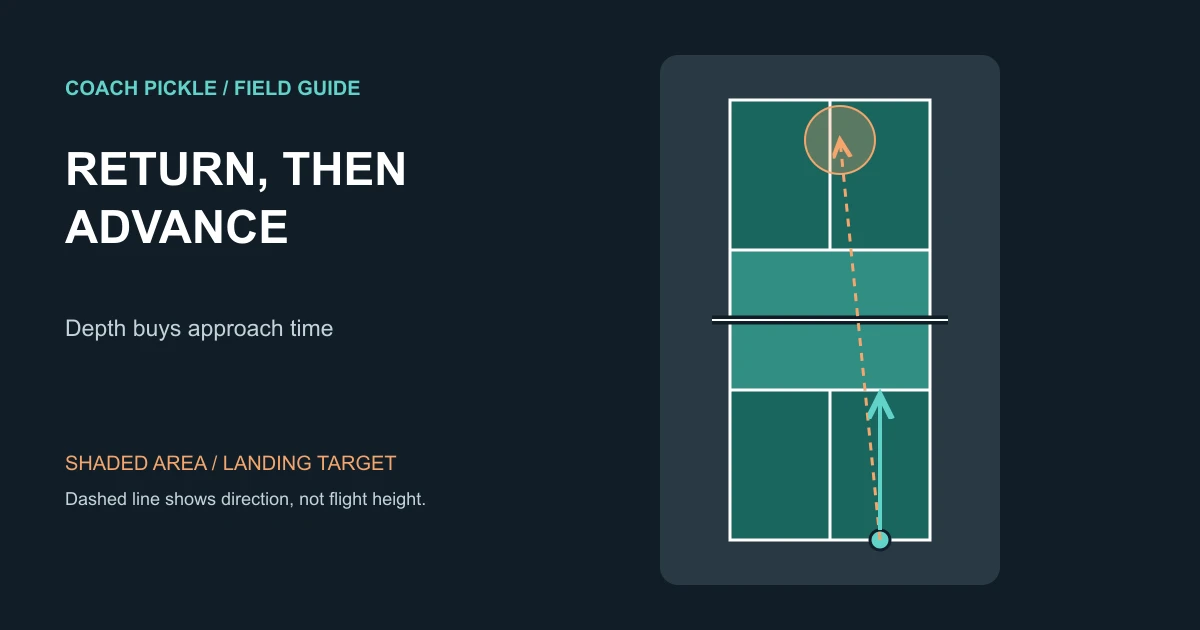
The return is a positioning shot
In doubles, a good return gives you time to join your partner at the kitchen line while forcing the serving team to play its third shot after a bounce. You are trying to create a strong team position, not simply hit the fastest possible second shot.
Depth usually matters more than pace. A firm but very fast return may come back before you are ready. A higher, controlled return that lands deep often buys more time. This is a tactical default rather than a rule: a short serve may give you a different opportunity.
Start far enough back
The serve must bounce before you return it. Begin behind the baseline with room to handle a deep ball, adjusting to the server’s pace and your movement. If you stand too close and the serve lands at your feet, you may be forced into a rushed half-volley.
Stay light on your feet with your paddle in front. Watch the release and flight, then make small adjustment steps. Move toward short serves early; waiting to see the bounce can leave you reaching. For deep serves, create space behind the bounce rather than trying to swing through a crowded contact.
Use a controlled swing
- Turn your shoulders early enough to prepare the hitting side.
- Move to a spacing that allows contact in front without stretching.
- Keep the backswing modest, especially against a hard serve.
- Send the ball over the net with a comfortable margin and a deep target inside the lines.
- Recover and begin moving forward as your balance allows.
Against pace, borrow some of the incoming speed. A large swing can magnify timing errors. Against a softer ball, supply a little more lift and follow-through. In both cases, aim to make contact from a stable base instead of letting your forward run drag the paddle through the ball.
Choose a target that supports your team
A deep middle return is a useful beginner default: it avoids the sidelines and can limit the opponents’ angles. A return toward a weaker third-shot player can also be effective. Crosscourt gives a longer flight path, but it is not automatically best in every situation.
Avoid repeatedly aiming at a sideline just to make the return look aggressive. A missed return gives the serving team a point in traditional scoring. A safe return lets you use the receiving team’s positional advantage.
In singles, you may choose direction to move the server and set up the next passing shot. Your approach must account for covering the whole court, so the doubles instruction to join a partner at the kitchen does not transfer unchanged.
Move forward, then be ready to stop
Follow your return toward the kitchen in doubles, but watch the opponent preparing the third shot. Settle into a balanced split step around their contact. If you cannot reach the line in time, stop in the transition area and play the next ball from balance. Running through contact creates pop-ups and missed volleys.
Your partner should adjust with the ball and protect the middle. Communicate if a short return leaves you exposed. Reaching the line is valuable, but both players being prepared for the next shot matters more than arriving at any cost.
Common problems and practical fixes
Returns land short: add a little arc or a fuller finish and move the target deeper. Depth does not require maximum power.
Deep serves jam you: start farther back and prepare earlier. Check positioning before blaming your swing.
You get caught moving: stop sooner when the opponent is ready to strike. Practice the return and approach as one sequence.
You overhit soft serves: shorten the swing and keep a generous target. A slow ball still rewards clean spacing.
Practice the whole sequence
Ask a partner to serve ten balls to your forehand and ten to your backhand. Record returns in, returns in the deep target area, and whether you were balanced for the next shot. Those are three different measures; a deep ball followed by a rushed approach still needs work.
Then play cooperative serve-return-third-shot sequences. The server varies depth and sends the third-shot drop gently toward your feet or paddle. Your task is to return, move, stop, and make a controlled fourth shot. Reset after each sequence rather than turning it into a winner contest.
Finish with live points in which your only process goal is a deep return and a balanced stop. When that holds up, experiment with direction. Build dependable position first, then make the return more demanding.
Frequently asked questions
Does the serve have to bounce before you return it?
Where should you stand to return a pickleball serve?
Should a pickleball return be deep?
Should you move to the kitchen after returning serve?
Practice returns of serve with Coach Pickle
Download Coach Pickle to build a return-and-move practice plan, find footwork drills, and ask your AI coach how to handle the serves that trouble you.