Pickleball footwork: arrive balanced and move as a team
Learn split steps, spacing, transition-zone movement, and doubles positioning that make every shot easier to control.
By Coach Pickle coaching team · Last updated
Good feet make simple strokes possible
Footwork creates a comfortable contact point and a balanced recovery. It is not just moving faster. A player who arrives early but crowds the ball may still have a difficult shot; a player who takes one extra adjustment step may swing more calmly with less effort.
Your goal is to move, organize your body, hit, and recover. The sequence changes with the time available, but balance remains central. Most tactical errors become harder to correct when you are still running as the opponent strikes.
Use the split step as a readiness moment
A split step is a small settling action timed around the opponent’s contact, leaving you able to move either way. It can be subtle; it does not require a large jump. Land or settle with knees soft and weight ready to shift.
If you split much too early, you may become flat-footed before the direction is clear. If you do it too late, the ball is already passing you. In practice, watch the opponent’s swing and aim to be balanced as you read the outgoing flight.
Create space before hitting
For groundstrokes, turn and move early enough to contact in front without reaching or crowding. Use small adjustment steps near the ball. A ball coming directly at you may require moving away to create swing room rather than stepping toward it.
Near the kitchen, short lateral steps help preserve readiness. For a ball much farther away, a crossover or turn-and-run may cover ground more efficiently. The appropriate movement depends on distance and time; do not insist on shuffling across the entire court.
Stay low through contact when playing soft shots, but avoid locking into a deep squat that prevents movement. Your stance should feel athletic and adjustable, not fixed for the whole rally.
Move through the transition area in stages
The transition area is the space between the baseline and kitchen. You often pass through it after a return or behind a drop. You can also be forced to play there for several shots. Its difficulty comes from balls arriving at your feet and opponents having better angles.
Move forward when your shot buys time, then stop for the opponent’s contact. If the next ball is low, use a controlled drop or reset. Advance again only if the reply supports it. A balanced midcourt contact is preferable to a rushed contact a few feet nearer the net.
This gives you a simple rhythm: hit, read, move, settle. Do not decide in advance that you must reach the line in one continuous run.
Coordinate with your doubles partner
When the ball moves wide, both players generally shift toward its side while preserving sensible spacing. The nearer player covers the most immediate angle; the partner helps protect the middle. Exact positions depend on the opponents and the ball, so avoid treating the center of each service box as a permanent home.
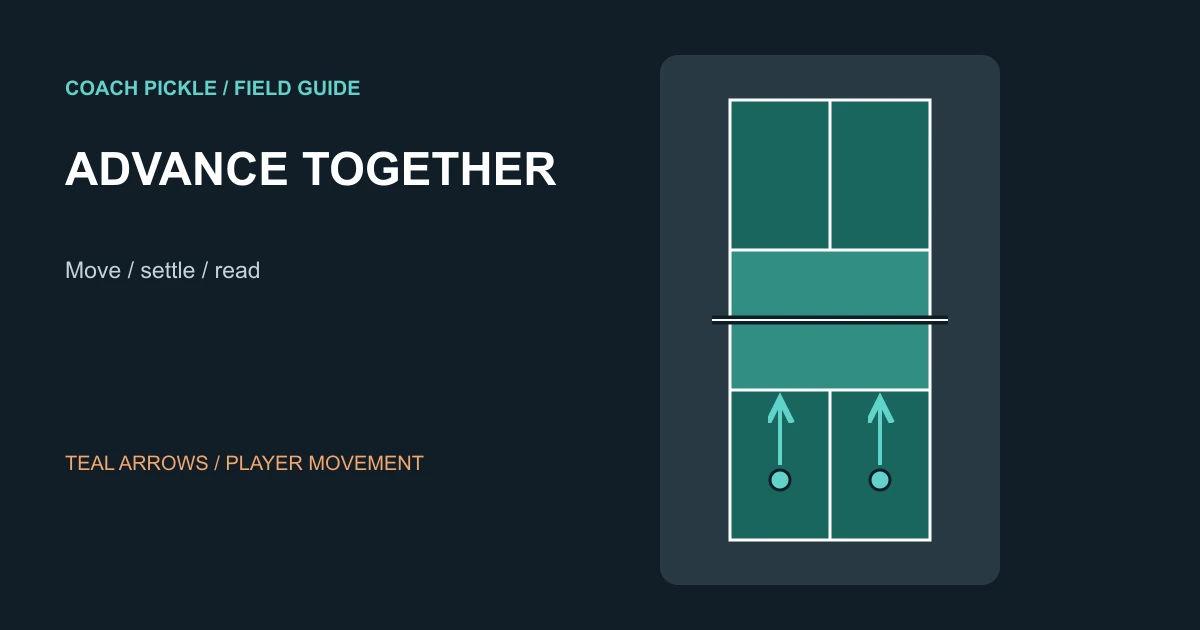
Try to avoid a large front-to-back gap during an approach. An opponent can attack the deeper player’s feet or the space between partners. If one player is delayed, the other should recognize the exposure and adjust rather than standing at the line unaware.
Communicate before shared contacts. A clear “mine” or “yours” early in the flight is more useful than two late swings. After a wide recovery, rejoin your partner’s coverage instead of remaining stranded at the sideline.
Handle lobs with a turn
If a lob passes you, turn and move toward it rather than backpedaling while looking straight upward. Communicate who is chasing and whether you are switching sides. If an overhead is not comfortable, let the ball bounce and make a controlled return when possible.
Practice this at modest speed with plenty of space. The aim is a safe turn, good tracking, and a balanced next contact, not a dramatic running smash.
Fix movement problems at the source
If you are constantly reaching, start moving earlier and check your initial position. If you are jammed, create space away from the ball. If you pop up transition shots, stop before contact. If you and your partner leave the middle open, practice shifting together rather than separately chasing each ball.
Video can reveal whether the stroke problem actually began several steps earlier. Look at your preparation and balance before focusing only on the paddle.
Practice without and with a ball
Begin with shadow movements: start at the baseline, move forward, settle on a partner’s clap, and repeat. Then have a partner point left or right after you settle so you practice reacting rather than guessing.
Add gentle feeds that require two or three adjustment steps before a controlled shot. Finally, play cooperative approach rallies with your partner and stop each time either player is caught running at contact. Measure balanced contacts and coordinated advances. Speed becomes useful once those habits stay intact.
Frequently asked questions
What is a split step in pickleball?
Should you run straight to the kitchen after a drop?
How should doubles partners move together?
How do you move back for a lob safely?
Practice footwork and positioning with Coach Pickle
Download Coach Pickle to find footwork drills, build a movement-focused workout, and get coaching advice on the positions where you feel rushed.